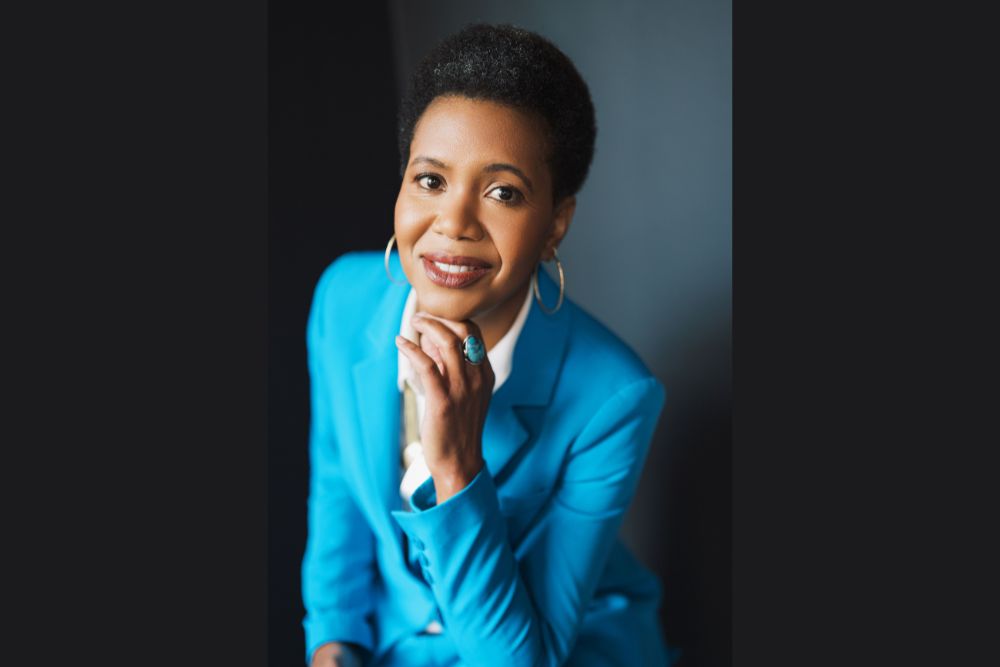
Dr. Simms on the system designed to undermine Black suburban wealth
Prince George’s County, Maryland, is home to the highest concentration of Black middle-class residents in the entire United States and has been led by Black officials for over 30 years. By almost every conventional measure it should be thriving. And yet the county consistently struggles to generate the tax revenue needed to provide the quality public goods and services its residents deserve.
Dr. Angela Simms spent two years inside that contradiction, interviewing nearly 60 county leaders and residents and analyzing budgets across multiple jurisdictions to understand why. She is an Assistant Professor of Sociology and Urban Studies at Barnard College, Columbia University, a former federal government analyst under both the George W. Bush and Barack Obama administrations and the author of Fighting for a Foothold: How Government and Markets Undermine Black Middle-Class Suburbia. Rolling Out sat down with Dr. Simms to talk about what Black families are actually up against and what needs to change.
Prince George’s County is home to the highest concentration of Black middle-class residents in the country. Most people would assume a community like that would be thriving financially. Why is that assumption wrong?
Prince George’s County is doing well in many respects and it is important not to lose sight of what is positive about it. At the same time the county faces constraints that white middle-class communities do not. Black Americans still carry the cumulative effects of anti-Black racism that began with slavery, moved through Jim Crow and now continue through ostensibly race-neutral policies that still produce racial disparities in who benefits and who is burdened.
One of the most consequential of those disparities shows up in home values. Most Americans build wealth through home ownership, but Black space is discounted by market actors by approximately 25% regardless of the quality of private amenities or public services in a given area. That means the trajectory of a Black family’s most important asset is more shallow than it would be in a white community. It also means that local jurisdictions relying on property taxes to fund public goods and services are working with a structurally diminished tax base.
Home ownership used to be the defining marker of the American middle class. How did we get to a place where that dream is slipping away and are Black families losing it faster than anyone else?
The United States is in a period of growing inequality. There are now 400 billionaires in this country and 40 million people in poverty. Those are not parallel facts. They are interconnected ones. Wealth is concentrating at the top while middle-class and lower-income families are being squeezed. Black Americans experience that squeeze more harshly because they start with less wealth. The wealth gap between Black and white Americans sits somewhere between 8 to 1 and 10 to 1 depending on how it is measured, meaning that for every $8,000 to $10,000 a white family has, a Black family has $1,000.
That gap matters beyond homeownership. Wealth is what allows a family to weather a job loss, a health crisis or any of the ordinary disruptions of life. Without it, Black families are more likely to be downwardly mobile over their lifetime and less likely to reproduce middle-class status for their children. The labor market compounds this. Black Americans still face employment discrimination and have historically been concentrated in civil service work, which has been systematically reduced in ways that are not unrelated to the politics of the civil rights era.
Why do Black communities continue to face financial challenges despite high levels of education and home ownership? What is the system doing that individual achievement simply cannot overcome?
The cumulative effect of policy choices is the answer. The story goes back to slavery and the fact that emancipation was never followed by reparations, by any material provision that would have given Black Americans an economic foothold. Despite the odds, Black communities built churches, businesses, schools and institutions. But when those communities succeeded and white Americans felt threatened, they were destroyed. Think of Tulsa. Think of the dozens of other Black Wall Streets across the country that were burned without consequence. Couple that with redlining, racial terror and lending discrimination and you begin to understand why Black wealth has been structurally suppressed at every turn.
On the 250th anniversary of America it is worth telling the whole truth about who this country was built for and at whose expense.

You use the phrase relative regional burden to describe what Prince George’s is experiencing. What does that mean?
Relative regional burden captures the unique conditions that Black households, neighborhoods and local jurisdictions face, but the relative part is the key. Prince George’s County not only has less capacity to generate tax revenue than its wealthier white neighbors. It is also effectively subsidizing those neighbors.
When Prince George’s invests in training civil servants, from code enforcement officers to teachers, those workers gain experience and then cross the county line to take higher-paying positions in neighboring jurisdictions that have more tax revenue. Prince George’s County does the upfront work and the wealthier counties reap the benefit. Residents also spend money in neighboring counties because markets underinvest in Black jurisdictions, which means the economic activity and tax revenue generated by that spending flows outward. And because Prince George’s is more affordable than its neighbors, it absorbs a disproportionate share of the region’s low-income workers who provide labor across the region but whose needs are the responsibility of Prince George’s County alone.
Prince George’s uses the same revenue strategies as majority-white counties but does not get the same financial returns. Why not?
Because the tools produce lower yields when the underlying conditions have not been corrected. A clear example is the Amazon second headquarters competition. Prince George’s County was the only jurisdiction in the DC area that did not make the shortlist. They were told directly that their public schools were not good enough for the company’s workers. A wealthier white county received the headquarters and the high-paid workers who bolster its tax base. Prince George’s County received the warehouses and the working-class workers who come with them. That outcome is not a coincidence. It is the system working exactly as it was designed.
What is the most urgent policy change that would make the biggest difference for communities like Prince George’s?
If going for the high-hanging fruit the answer is reparations, understood as repair. This country was built through enslaved labor and those people were never compensated. The downstream effects of that foundational theft show up in every inequality being discussed today, from the wealth gap to home values to school quality to health outcomes. You cannot correct a harm simply by declaring it illegal. You have to put as much energy into the correction as went into the harm itself.
In the shorter term, federal and state taxes on wealthy Americans and corporations need to increase so that government has the capacity to distribute resources equitably. State-level funding for public goods needs to increase so local jurisdictions are less dependent on locally generated property tax revenue. Equity funds need to be created to remediate documented harms to Black communities. And investments in early childhood education, universal healthcare and financial tools for young people need to be prioritized as the downstream interventions that actually change life outcomes.
For a Black family that has worked hard, moved to the suburbs, bought a house and done everything they were told to do, what do you want them to understand after reading your book?
They are experiencing a form of collective gaslighting. The country has told Black families to just work harder, just play by the rules and they can win. But the rules are not designed for them to win by. Knowing that is not a reason for despair. It is a reason for sober-minded, strategic thinking.
It means understanding that a home in a Black neighborhood may not appreciate the way a comparable home in a white neighborhood would, and planning accordingly. It means having honest family conversations about protecting individual financial stability even while supporting extended family members. It means learning the county and state budgets and knowing which levels of government are actually responsible for the conditions in your community. And it means organizing within churches, civic institutions and coalitions to bring a clear agenda to elected officials rather than simply reacting to what they do.
The rules are rigged. But knowing that is the beginning of changing them.
Fighting for a Foothold: How Government and Markets Undermine Black Middle-Class Suburbia is available now at Amazon, Barnes and Noble and directly from the Russell Sage Foundation. To follow Dr. Simms’ research and speaking engagements visit drangelasimms.com, find her on LinkedIn as Angela Simms, on Facebook as Angie Simms and on Instagram at angie.ang17.