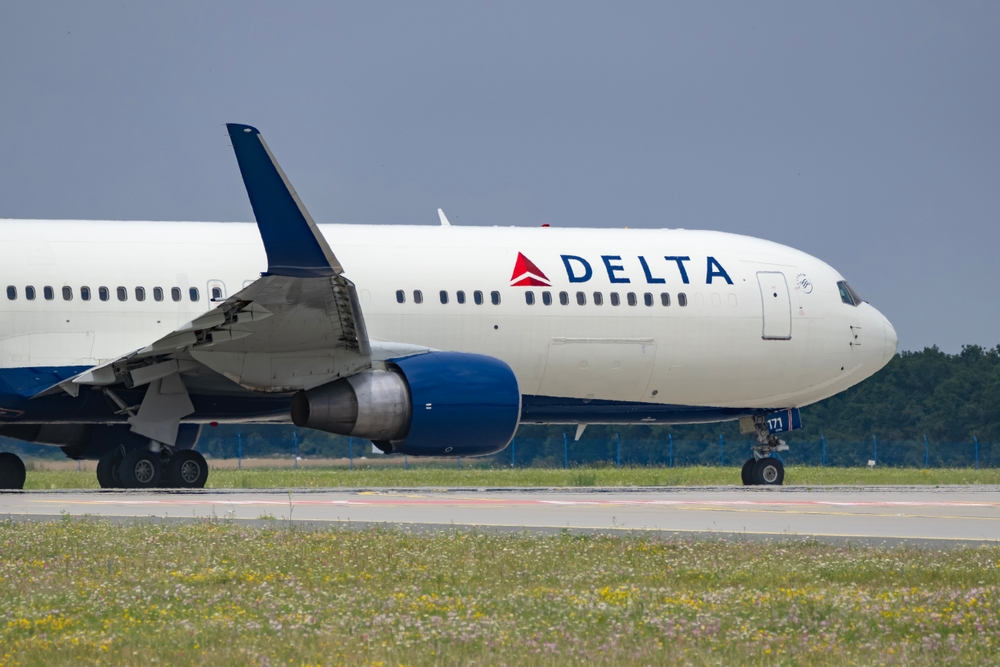
A drunk passenger’s racially abusive tirade on a Seattle-to-Taipei flight forced an emergency landing in Anchorage and triggered federal charges that could result in decades behind bars
A Delta Air Lines flight traveling from Seattle-Tacoma International Airport to Taipei Taoyuan International Airport was forced to divert to Anchorage International Airport on March 14 after a passenger’s behavior escalated from disruptive to dangerous — and ultimately criminal. The passenger, identified as 60-year-old Malcom Martin, now faces federal charges that carry a potential prison sentence of up to 20 years under statutes governing interference with flight crew members.
The incident serves as one of the starkest recent reminders that disruptive behavior in the skies is not simply a matter for airlines to handle internally. When it crosses into federal territory, the consequences can be life-altering.
How the incident unfolded
According to reports, Martin had been drinking during the flight and began behaving erratically and aggressively toward a flight attendant. What the crew initially attempted to manage as a standard disruptive passenger situation deteriorated rapidly. Martin allegedly directed a racial slur at the Black flight attendant and followed it with additional abusive language, transforming what had begun as general unruly conduct into an act of targeted racial harassment.
The situation worsened further when Martin allegedly swung at a crew member who attempted to intervene and issued verbal threats toward the staff. At that point the crew made the determination that his behavior constituted direct interference with their duties — a threshold that triggers serious federal consequences — and the decision was made to divert the aircraft to Anchorage for safety reasons. Law enforcement met the flight upon landing and arrested Martin, with federal prosecutors subsequently pursuing charges that could result in up to two decades in prison if a conviction is secured.
Why federal law treats this with such severity
Flight attendants occupy a critical safety function that extends well beyond customer service. Their ability to perform duties without interference is considered essential to the safe operation of every flight, and federal law reflects that priority directly. Threatening, assaulting or obstructing crew members in the performance of those duties is treated as a serious criminal matter, not merely an airline policy violation. The result is that what may begin as a verbal altercation at 35,000 feet can quickly become the basis for federal prosecution.
The use of a racial slur adds a further dimension to this case, one that airlines and regulators have been increasingly vocal about addressing. Carriers have responded to rising incidents of discriminatory conduct by expanding crew training on harassment response and de-escalation techniques, and many have reinforced zero-tolerance policies that apply regardless of the nature of the abuse.
A persistent industry-wide problem
This incident does not exist in isolation. The Federal Aviation Administration has tracked unruly passenger reports for years, and the data tells a sobering story. Reports climbed from 544 in 2017 to a peak of 5,973 in 2021, a period shaped heavily by pandemic-era tensions, mask mandates and staffing disruptions. Since then the numbers have declined, falling to 1,621 in 2025, but 312 incidents had already been reported in the early months of 2026 alone — a pace that suggests the problem remains far from resolved.
Alcohol has been a contributing factor in a disproportionate share of high-profile cases, including multiple incidents that have required emergency diversions, caused significant operational disruptions and resulted in criminal charges for those involved. Airlines have responded by tightening onboard alcohol service policies and working more closely with federal regulators to ensure stricter enforcement, but the challenge persists across the industry.
What this case signals going forward
The charges facing Martin represent exactly the kind of outcome that federal authorities and airlines have been signaling they will pursue with increasing consistency. The message being reinforced across the industry is that verbal abuse, racial harassment and physical aggression in the cabin are not matters that will be resolved with a ban from a single carrier. They carry real criminal exposure, and this case is a direct illustration of what that exposure looks like when authorities choose to pursue it fully.
For the crew members involved in the March 14 incident, the diversion and arrest represented the system working as intended. For Martin, a flight that began in Seattle now carries the weight of potential federal conviction and a prison sentence that could define the rest of his life.
Source: Simple Flying