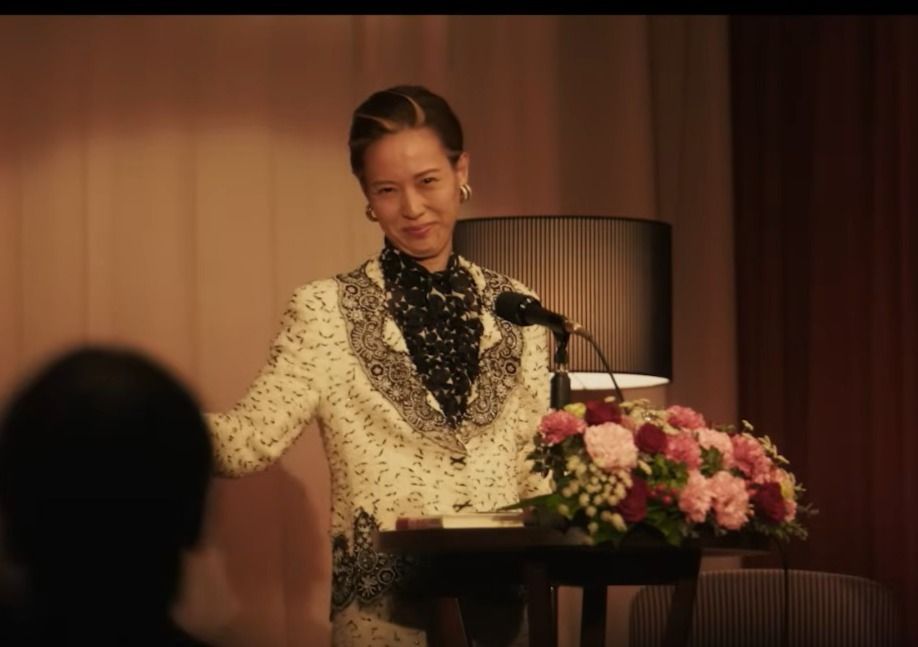

Straight to Hell, the new nine-episode Japanese biographical drama on Netflix, is one of those shows that stays with you long after you have finished watching it. Starring Erika Toda as the real-life controversial fortune teller Kazuko Hosoki, Straight to Hell traces her extraordinary rise from post-war poverty in Tokyo all the way to becoming one of the most powerful and recognisable media personalities in Japan.
But the finale is not the triumphant or tragic ending you might expect, and a lot of people have been sitting with questions about what it all actually means when the credits roll. Here is a full breakdown of everything that happens and what Straight to Hell is really trying to say by the end.
The story is told through the eyes of writer Minori Uozumi, who is hired to write Kazuko’s official biography. What starts as a seemingly straightforward job slowly becomes something far more complicated as Minori begins to uncover inconsistencies and half-truths woven into every version of Kazuko’s life story. What started as a biography eventually becomes something much closer to an investigation.
By the time the finale of Straight to Hell arrives, Minori has completed the manuscript. Kazuko reads it and tears it to pieces, but the show makes clear that the words have gotten inside her, forcing her to quietly sit with the parts of herself she has spent sixty years burying. Though Minori knows the book may never be published, she finds peace in the fact that Kazuko was its one true reader.
What does the finale of Straight to Hell actually show, and why does it refuse to give a simple ending?
The exposé article that Kazuko had been trying desperately to hide eventually gets into a magazine, and the magazine decides to continue featuring her story for fifteen weeks. All her contracts are shown to be cancelled, and she completely retracts herself from the public eye. For an individual who had her entire identity created as a result of being acknowledged, not being noticed at all would have been a hard blow with her.
But even that is not the end of Kazuko, and Straight to Hell is very deliberate about that. After stepping away from television, Kazuko simply changes her approach. She launches a new fortune-telling app that turns her Six-Star Astrology into a digital phenomenon and makes her significantly more money than she was earning before. She eventually adopts her niece and lives out her final years surrounded by family. She died in 2021.
The final scene of the show belongs entirely to Kazuko. Alone in her enormous glass-walled house, she cannot find her dog, Tiara, and wanders through the empty rooms looking for her. The camera holds on her in that vast, silent space, and the image does all the work the words do not need to do anymore, and this is what the castle looks like from the inside.
She is confronted by her younger self, a child from 1946, hungry and resourceful, who developed an edge in an environment that was ripped apart around her. The younger version of her tells her she is headed “straight to hell.” The older version replies that she has been there too many times, so she does not fear it anymore. That is the exit, and it is quite lonely and depressing.
What Straight to Hell is really saying, and whether this is based on a true story
Rather than delivering a clean punishment or a satisfying moral lesson, the show suggests something more complicated and more honest that sometimes the truth comes out, but it does not fundamentally change the person at the centre of it. Kazuko is neither fully defeated nor completely untouched by the end. She adapts, as she has always adapted, and moves on.
The title of the show itself is also quietly redefined by the finale. For most of the series, “straight to hell” was a threat Kazuko used against others, one of the famous phrases that made people afraid of her. By the end, hell is no longer a place you go after death. It is the life you build inside the consequences of who you choose to become.
Straight to Hell is based very closely on real events. The real Kazuko Hosoki did indeed build a media empire through television, books, and fortune telling, had genuine ties to powerful underworld figures, and was exposed by the Weekly Gendai magazine in 2006 through a series of articles that ended her television career. She did return through digital platforms and lived until 2021. Straight to Hell is streaming now on Netflix.
Edited by Priscillah Mueni