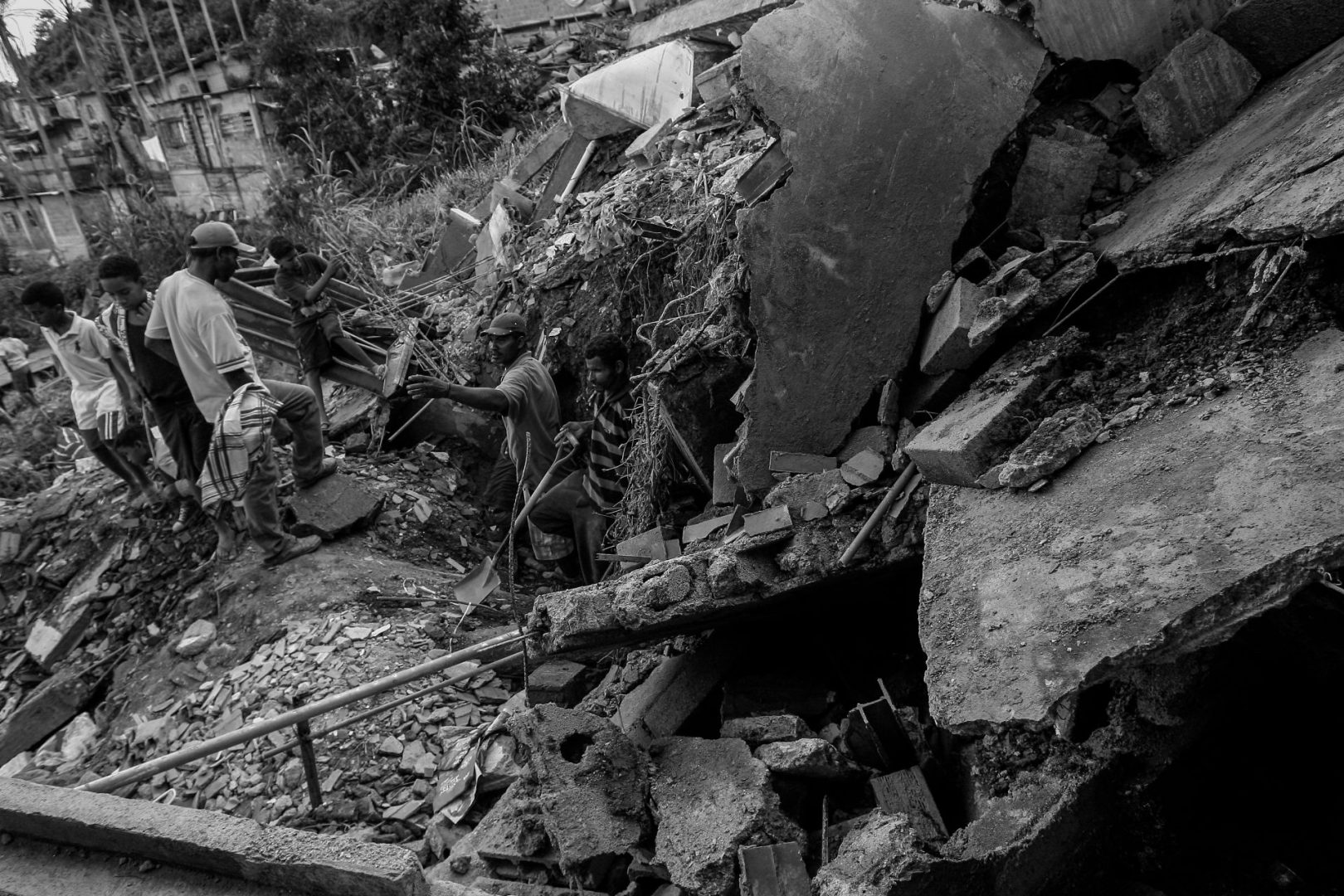
Rescue teams from Colombia, Mexico, and the United States pulled 33 people from collapsed buildings
More than three days after twin earthquakes tore through Venezuela’s northern coast, rescue teams were still pulling people from the rubble Today, defying the odds that experts say grow longer with each passing hour. The official death toll stood at 1,430, but authorities and aid workers have said the real figure is almost certainly higher, with tens of thousands of people still unaccounted for across the devastated coastal state of La Guaira and the capital Caracas.
Among the 33 people recovered alive over the weekend was an 11-year-old boy named Moises, who was found nearly 10 feet below the surface of collapsed rubble in La Guaira by a Colombian rescue team that worked for six hours to reach him. A structural void created by the way the building collapsed had shielded him from injury, and he emerged without physical harm. A US team separately pulled an infant alive from the debris. A Mexican crew rescued another 11-year-old in the coastal town of Caraballeda.
Each rescue has drawn cheers from the crowds gathered around affected sites, a release of tension and grief from people who have spent days watching teams dig through concrete in tropical heat.
The scale of what the earthquakes destroyed
The 7.2- and 7.5-magnitude earthquakes struck within seconds of each other on Wednesday, an event that seismologists have described as the most powerful to hit Venezuela in more than a century. The worst damage is concentrated in La Guaira, a coastal state about 20 miles from Caracas that has been largely cut off from the capital because of collapsed roads and damaged bridges. Entire apartment towers, hotels, and government housing complexes collapsed or were rendered uninhabitable. Hundreds of aftershocks have continued to rattle damaged structures, complicating rescue operations and preventing displaced residents from safely re-entering buildings.
Food and clean water have become scarce in La Guaira. Some residents have taken essential supplies from stores in the area. Families have been digging through debris with their hands to search for relatives because professional rescue resources have been stretched far beyond their capacity to respond. The missing toll reported by families has fluctuated between roughly 50,000 and nearly 69,000, a range that reflects the chaos in communications and the difficulty of accounting for people displaced, cut off, or buried.
Families waiting with no answers
The faces of the disaster are individual. A 43-year-old woman named Mileidy Duque described searching for her 82-year-old mother, her brother, her daughter, and her daughter’s partner, all of whom were living in a government housing building that collapsed. A man named Lindomar Milla sat outside the Caracas morgue after learning his sister and brother-in-law were confirmed dead, describing the particular anguish of families who have no confirmation at all.
In the upper-middle-class Palos Grandes neighborhood of Caracas, a woman named Susana Henríquez stood behind yellow tape looking at what remained of the residential complex she had escaped from. The building next to hers had collapsed entirely. Her friends were inside.
Residents have also described what it is like to move through neighborhoods where the smell of decay has grown strong enough in the tropical heat that many are wearing face masks. The 72-hour window that rescue experts describe as the critical period for finding survivors alive closed Saturday evening. Teams have continued working past it, and Moises is evidence that the window is a probability, not a certainty.
A government struggling to respond
Venezuela’s acting president, Delcy Rodríguez, has told the public that the country is not facing this alone, and international assistance has arrived from Colombia, Mexico, Switzerland, and the United States, among other countries. The Trump administration pledged $150 million in aid and deployed Navy warships to support the humanitarian effort. Starlink announced it was providing free satellite connectivity to mobile customers in the La Guaira region to help restore communications.
But the disaster has landed on top of decades of economic mismanagement and institutional decline that have left Venezuela with weaker emergency infrastructure than the scale of this event demands. Firefighters lack necessary equipment. Victim identification has in some places relied on handwritten lists passed between families. The government’s capacity to mount a coordinated response at the speed the situation requires has been visibly strained.
Some Venezuelans have said openly that the inadequacy of the response reflects not just the scale of the disaster but the accumulated consequences of years of neglect. For others, that conversation belongs to a later moment. The immediate work is finding people who may still be alive.
Communities holding each other up
Alongside the official response, informal networks of mutual aid have spread across the country and beyond. University students in Caracas organized supply collections and moved through the city distributing food and essential goods. Donation drives have been set up in Miami, New York, and Madrid, cities that host large Venezuelan diaspora communities. A Miami resident named Marcos Mirabal described arriving at a collection site with diapers, flashlights, and clothing from his daughters’ wardrobes.
Pope Leo addressed the earthquake at Today’s Angelus prayer in Rome, expressing solidarity with survivors and victims‘ families in Spanish.
The search continued Today with international rescue teams, civil protection units, and trained dogs working alongside civilians who have not stopped digging. The full accounting of the dead will take time. The question of whether Venezuela can rebuild, physically and institutionally, from a disaster of this magnitude falling on a country already in profound crisis, is one that has no immediate answer.
For now, the work is pulling people from the rubble. Moises is proof that it is still worth doing.