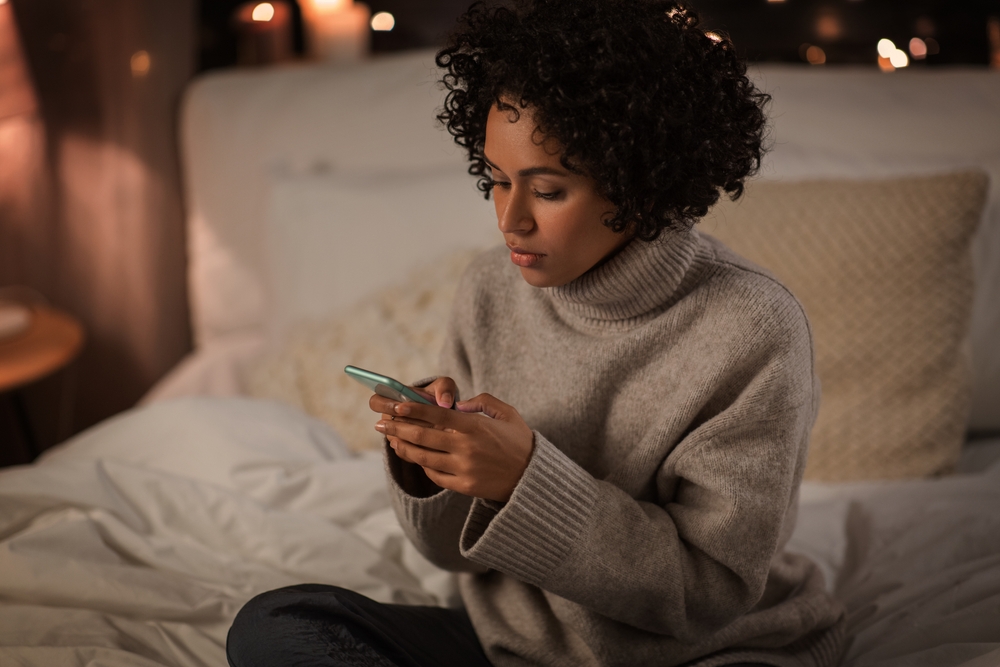
Most people know that staring at a screen before bed is not ideal. But knowing and stopping are two different things — and the habits that form around late-night phone use tend to be far more damaging to sleep than most people realize.
Sleep researchers have spent years documenting what happens to the brain when it is exposed to stimulation right before rest. The findings are consistent— the phone is one of the most disruptive tools in existence for sleep, and the specific ways people use it at night make a significant difference in how well — or how poorly — they rest.
The blue light problem goes deeper than you think
The most well-documented effect of nighttime phone use is blue light exposure. Screens emit a wavelength of light that signals to the brain that it is still daytime, suppressing melatonin — the hormone responsible for triggering sleep and keeping it going through the night. Even 30 minutes of screen exposure before bed can push back the body’s natural sleep onset by up to an hour.
What makes this particularly damaging is that the effect is cumulative. People who scroll nightly are not just losing sleep on any given night — they are gradually shifting their circadian rhythm in a direction that makes falling asleep earlier increasingly difficult over time. The body adapts to the disruption and starts to treat it as the new normal.
Checking notifications keeps the brain on high alert
Beyond light, the act of checking messages, emails, or social media before bed activates the brain’s alertness systems. Every notification is a potential trigger — a message that requires a response, news that demands a reaction, content that provokes emotion. The brain does not simply switch off after that kind of stimulation.
Researchers describe this as cognitive arousal — a state in which the mind actively processes information when it should be winding down. People who check their phones within an hour of sleep consistently report longer onset times and more fragmented nights. The habit feels passive, but the neurological response is anything but.
Doomscrolling and the cortisol connection
Doomscrolling — the habit of consuming an unending stream of negative or anxiety-inducing content — is among the most counterproductive things a person can do before sleep. Stress hormones like cortisol rise in response to distressing content, and elevated cortisol makes it physiologically harder to fall asleep and stay there. This applies to more than just news. Contentious social media threads, emotionally charged videos, and competitive content can all trigger a mild stress response that lingers well after the phone goes down.
Keeping a phone on the nightstand compounds the problem. Every middle-of-the-night check resets the arousal cycle and makes returning to deep sleep harder. Moving the device to another room and using a standalone alarm clock instead reinforces the brain’s association between the bedroom and rest rather than stimulation — a shift that has a measurable effect on sleep quality over time.
What actually helps
The research consistently points in one direction — a wind-down routine that keeps screens out of it. Reading a physical book, light stretching, or simply lying in the dark without a device can meaningfully improve the depth and consistency of sleep within a matter of weeks.
Putting the phone away 30 to 60 minutes before bed, silencing notifications after a certain hour, and removing the device from the bedroom are among the most accessible adjustments a person can make. None of them require a major lifestyle overhaul — just a shift in where the night ends and where sleep begins.