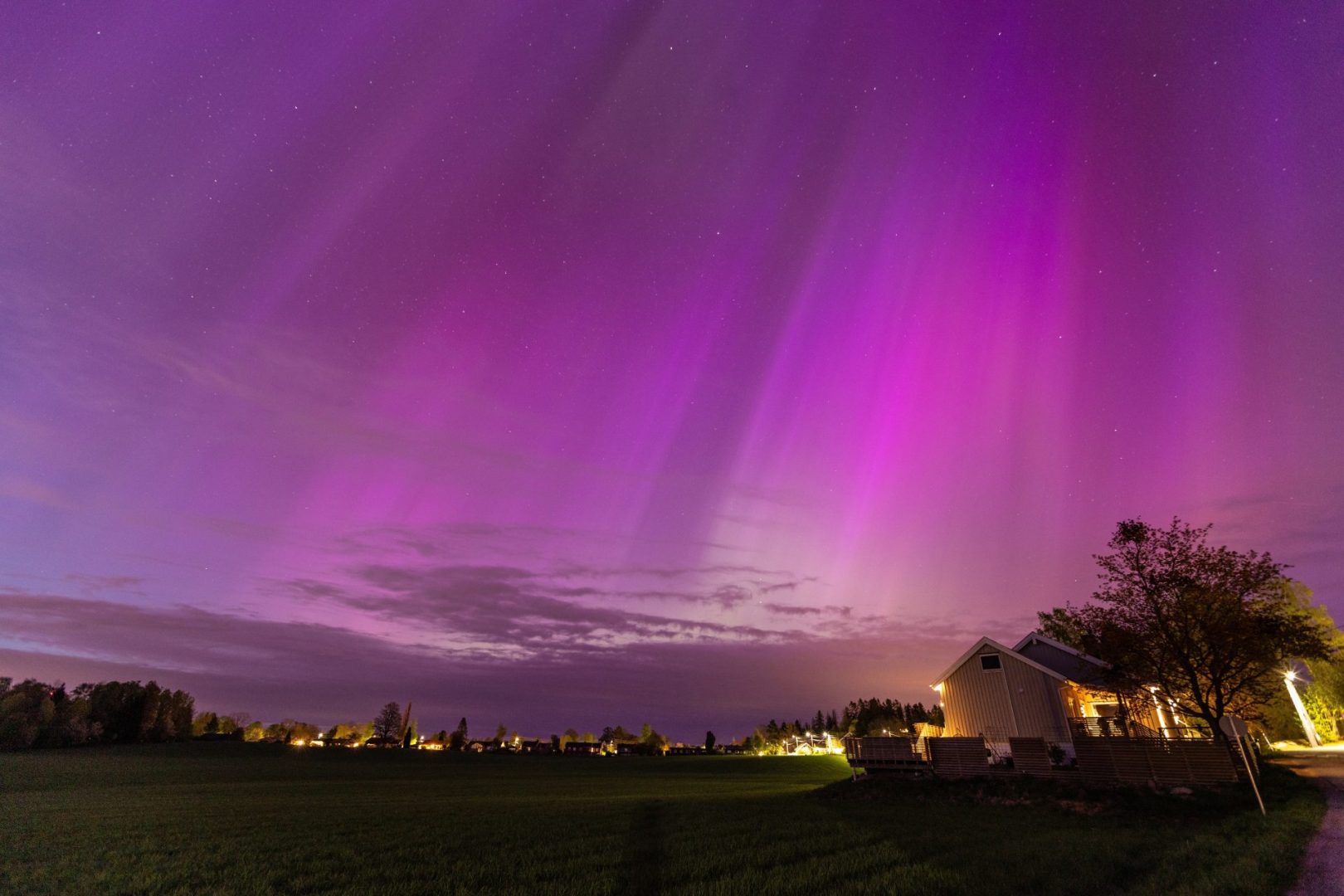
A powerful solar event is pushing the aurora borealis toward unexpected territory — and the window to see it is narrow
A surge of solar energy is making its way toward Earth, and it may bring one of the sky’s most dramatic light shows to parts of the United States rarely treated to such a display. The National Oceanic and Atmospheric Administration is forecasting a Kp index of five out of nine for Sunday night — a reading that signals the aurora borealis will burn brighter, stretch farther from the poles and take on more vivid shapes and movement than usual.
The catalyst is a coronal mass ejection, a massive expulsion of plasma and magnetic field from the outermost layer of the sun’s atmosphere. The ejection, which left the sun on Saturday, is projected to reach Earth by Monday. When it does, it will collide with the planet’s magnetosphere, triggering geomagnetic storms that could range from minor to strong — rated G1 through G3 on NOAA’s five-point scale. Those storms are expected to persist through Tuesday.
Strong geomagnetic disturbances have historically pushed the aurora as far south as Illinois, making this week’s forecast one worth paying close attention to for sky watchers across the northern United States.
The 9 States Where the Aurora May Appear
On Sunday night, NOAA forecasts a chance of visible aurora in states along the U.S.-Canadian border. The list includes North Dakota, the Upper Peninsula of Michigan, northern Minnesota, northern Montana and the northernmost edges of Washington, Idaho, Wisconsin and South Dakota.
For those already living in Alaska, the odds are considerably better. NOAA rates the aurora’s chances as “high” across much of the state Sunday night, making it the premier destination for anyone hoping to see the lights at their fullest.
How to Find the Best Viewing Spot
Location scouting makes a significant difference. NOAA experts recommend traveling as far north as possible — toward Earth’s magnetic north pole — and finding an elevated vantage point, such as a hilltop or open ridge, with an unobstructed view of the northern sky. Distance from city lights is equally critical; even modest light pollution can wash out the aurora’s softer hues.
Timing is just as important as location. The aurora is most active during the hours bracketing midnight — roughly 10 p.m. to 2 a.m. local time. Viewers who arrive early and allow their eyes to adjust will be better positioned to catch the display at its peak.
How to Photograph the Aurora With Your Phone
Smartphone cameras have become surprisingly capable aurora-photography tools, and the right settings can mean the difference between a blurry smear and a stunning image. Experts advise turning off the flash entirely and switching to night mode, which allows the camera sensor to take in more light over a longer exposure. Shooting in RAW format — available on most modern smartphones — preserves significantly more image data than standard JPEG compression, giving photographers more flexibility when editing.
The single most important rule for any aurora photograph, regardless of the device, is keeping the camera completely still. The long exposures required to capture faint light make any movement fatal to a shot. A tripod is the recommended solution, paired with a timed or remote shutter release to eliminate the small vibration that comes from tapping the screen.
Why This Week Could Be Exceptional
The combination of elevated solar activity and Earth’s current position in the sun’s 11-year cycle means geomagnetic events like this one are becoming more frequent. Scientists have noted that the sun has been particularly active in recent months, producing a series of coronal mass ejections that have pushed auroras to unusually low latitudes. This week’s event arrives with enough force to extend the aurora’s reach well beyond the Arctic Circle and into the contiguous United States.
For the nine states in NOAA‘s forecast zone, Sunday night and the days that follow represent a rare opportunity. The conditions will not stay favorable indefinitely — once the ejection’s energy disperses into the magnetosphere, geomagnetic activity will ease and the lights will retreat northward. Those hoping to catch the display should plan to be outside and watching before that window closes.
Source: Forbes