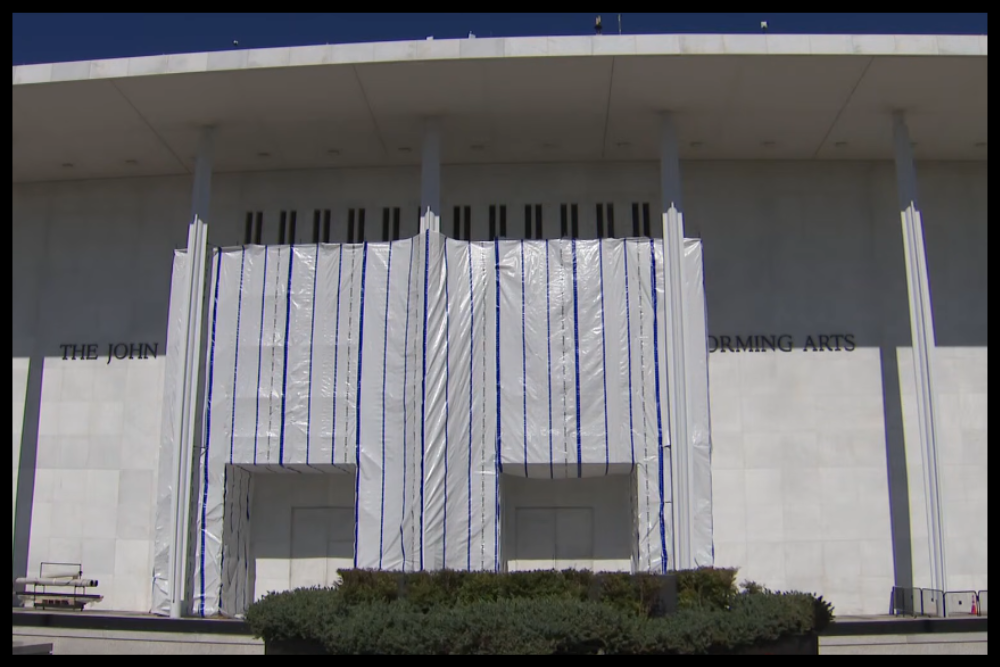
A week after Trump’s name came down, tarps still cover the Kennedy Center.
A week after workers removed Donald Trump’s name from the front of the John F. Kennedy Center for the Performing Arts under a federal court order, large tarps continue to hang over the Washington landmark, blocking public view of the restored facade and fueling a fresh political dispute over what is actually happening behind them.
Workers took the name down in the early morning hours of June 12, meeting a court-mandated deadline after the Kennedy Center board’s final legal effort to block the removal failed. An appeals court denied an emergency stay late the previous evening, and U.S. District Judge Christopher R. Cooper separately declined to pause his own ruling earlier that same day.
Why the name was removed
Judge Cooper ruled on May 29 that Trump’s name had been placed on the facility without legal authority. The Kennedy Center was created by Congress and can only be renamed by Congress, with the center’s own establishing law specifically designating it as a memorial to President Kennedy. The ruling found that the board of trustees Trump appointed had no authority to redesignate it when they added his name in December 2025.
Cooper’s ruling also blocked a planned two-year closure for renovations, finding the board’s decision to shutter the center had been made without adequate information or proper consideration of the institution’s legal obligations.
What the tarps are hiding
In a court filing, the Kennedy Center stated it had met its obligations under the ruling by removing all signage redesignating the facility under Trump’s name. A spokesperson said the tarps remained up to allow marble facade repair work, though no timeline for their removal was provided.
That explanation did not satisfy several Democratic lawmakers who had pushed for the name change’s reversal. Three members of Congress went public with criticism in the days after the June 12 deadline. Rep. Jamie Raskin of Maryland described the continued covering as deliberate concealment of what was underneath. Rep. Mike Levin of California suggested the Kennedy Center was keeping the tarp up with no real plan to take it down. Rep. Joyce Beatty of Ohio, who filed the original lawsuit challenging the name change, publicly mocked the board’s handling of the removal.
About 150 people had gathered outside the Kennedy Center on the morning of June 12 to watch Trump’s name come down, but the tarps blocked any view of the work being done.
The appeal and a new fund
The Kennedy Center board voted to appeal Judge Cooper’s ruling, a process that could take several weeks to resolve. In court filings, the board made clear it intends to restore Trump’s name to the building if the appeal succeeds.
In a separate move, the board created a new endowment fund in Trump’s name, framed as recognition of his role at the institution and intended to address the building’s physical disrepair. The fund was approved despite the court order barring use of Trump’s name to redesignate the center itself, underscoring that the legal and political dispute is far from over.
Judge Cooper has set a July 5 deadline for the Kennedy Center to update the court on its construction plans and how it will maintain public access and ongoing programming in the meantime.