A federal judge blocked the closure. The programming is gone and the staff is depleted.
The Kennedy Center will not close on July 5 as planned. A federal judge blocked that outcome weeks ago. What nobody has figured out yet is what happens instead.
In a court filing submitted Tonight, Kennedy Center Executive Director Matt Floca confirmed the building will remain open to the public beyond its planned closure date but acknowledged that no new shows are being booked and no additional staff are being hired. Those decisions, he wrote, are being deferred until the center’s board of trustees meets in mid-July to choose from three options: a full closure while renovations proceed, a partial closure with limited programming, or a phased series of closures paired with a more substantial performing arts schedule.
Until the board decides, the nation’s premier performing arts venue is essentially in a holding pattern with almost nothing on its calendar.
How the Kennedy Center got here
The crisis at the Kennedy Center began in February when President Trump announced on Truth Social that he would shutter the institution for two years for what he described as construction, revitalization, and complete rebuilding. The announcement caught board members and staff off guard, with many learning about the closure from the president’s social media post rather than from leadership.
What followed was described by one staff member as a self-inflicted crisis. Broadway tours that had been scheduled months or years in advance fell through. The National Symphony Orchestra, which has performed at the center since 1971, was destabilized. Its executive director resigned within weeks of the closure announcement. Waves of layoffs reduced the staff significantly, first early in the year and again in the spring under Floca, who was appointed to lead the center in March after replacing Richard Grenell.
U.S. District Judge Christopher Cooper blocked the closure on May 29 after Democratic Representative Joyce Beatty of Ohio, an ex officio board trustee, sued to stop it. Cooper found that the board had been derelict in its responsibilities when it ratified the closure decision without adequately weighing its obligations to the institution. He stopped short of permanently barring any future closure, leaving room for the board to revisit the question after more careful deliberation.
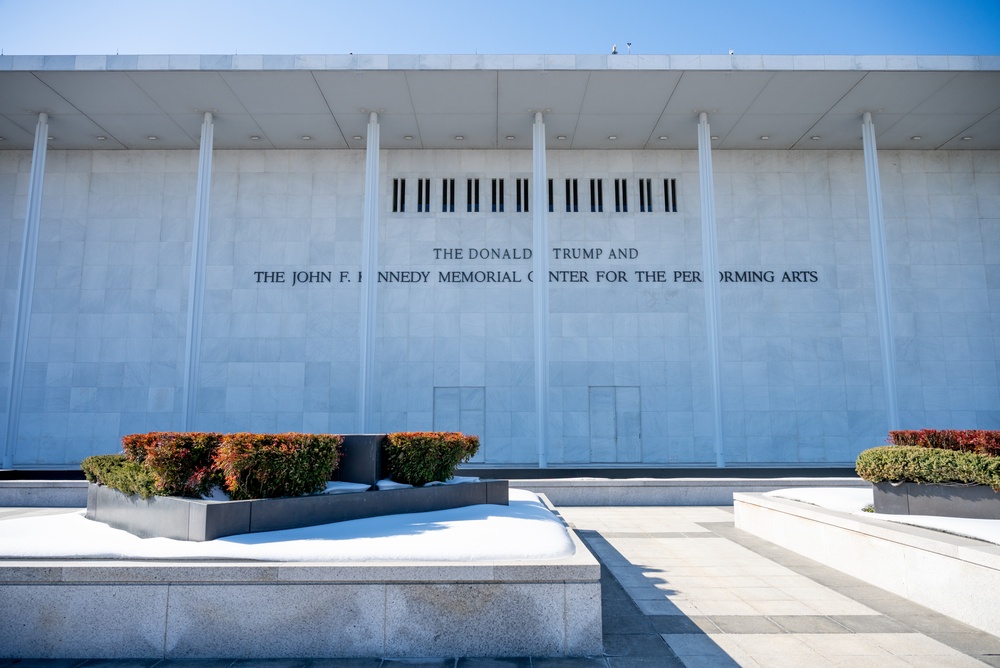
Cooper also ruled that the board had acted outside its authority when it voted to add Trump’s name to the center’s official title. Only Congress, the judge wrote, can change the name of the Kennedy Center, and the board’s unilateral decision to rename it was therefore invalid. The center’s name was restored to The John F. Kennedy Memorial Center for the Performing Arts, and the metal letters bearing Trump’s name were removed from the building’s exterior last weekend.
What the building looks like now
Large striped tarps continue to cover the area of the facade where Trump’s name was removed. Beatty’s legal team called the tarp a deliberate act of defiance in Today’s filing and accused the Kennedy Center of willfully damaging the building’s iconic appearance to satisfy political grievances. They described it as a clear breach of fiduciary duty.
Inside the building, the situation is similarly strained. The center’s current calendar consists of outdoor movie screenings, a children’s performance by the National Symphony Orchestra’s Summer Music Institute, and weekend art programming for children. The kind of full-scale Broadway-level programming that defined the center’s identity has largely disappeared.
Recovering that programming will not be fast. Touring companies book their schedules far in advance, and agents representing major acts have declined to commit to the Kennedy Center under its current leadership. Former staff familiar with the center’s operations have described the challenge of reassembling a world-class performing arts schedule as one that cannot be resolved on short notice regardless of what the board decides in July.
One proposed stopgap involves expanding National Symphony Orchestra performances to multiple nights per week. But as of this week, the orchestra’s contract with the center has not been renewed and its budget for the upcoming season has not been approved. The NSO has a plan ready but cannot move forward without board authorization.
What the court wants and what the center is offering
Cooper directed the Kennedy Center to explain Today what concrete steps it had taken to maintain public access and programming after July 5. The filing Floca submitted confirmed the building will stay open but did not commit to any specific programming beyond what is already on the calendar.
Beatty’s lawyers argued Today that the administration is effectively carrying out the shutdown through inaction, allowing the center to hollow out by declining to restore what was lost rather than actively closing the doors. They asked Cooper to require weekly updates on concrete steps being taken to resume programming.
The Justice Department asked for more time, suggesting both parties file a joint status report two weeks after the July board meeting. Whether Cooper grants that request will determine how closely the court monitors the center’s next steps.
The Kennedy Center board is chaired by Trump and composed largely of administration officials, allies, and supporters he appointed after taking office. That board will meet in mid-July to vote on a path forward for one of the country’s most recognized cultural institutions, one that has found itself at the center of a legal and political dispute that shows no sign of resolving quickly.