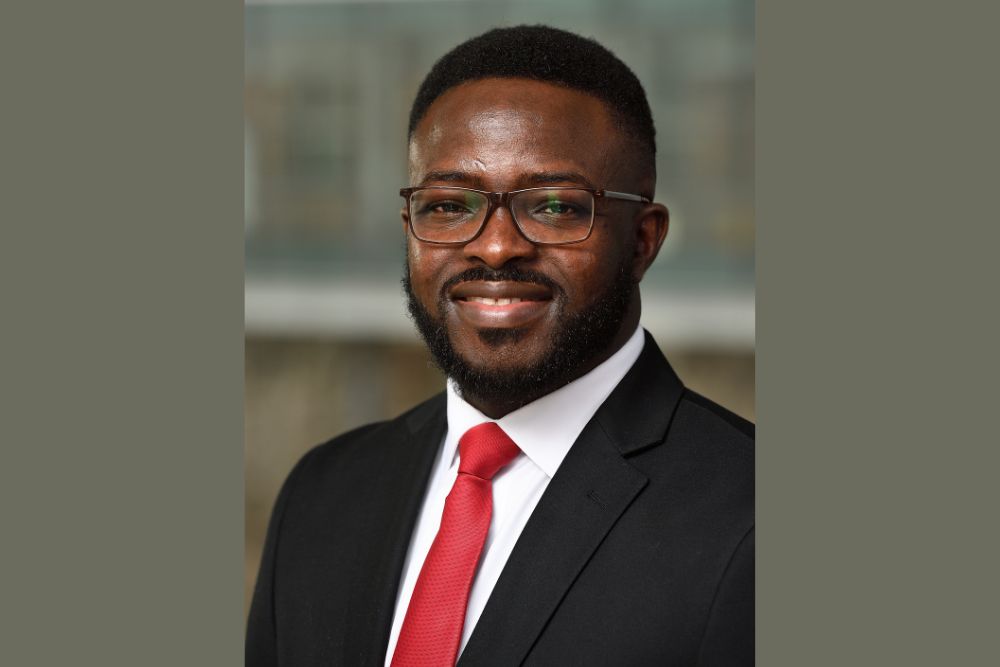
The Johns Hopkins physician and Concept Academy founder on mentorship, migration and medicine
Dr. Festus Oluseye Babarinde grew up in a small town in Nigeria where access to healthcare was limited and the idea of becoming a physician felt far away. Today he is completing his Master of Public Health at the Johns Hopkins Bloomberg School of Public Health, leads a global medical education platform reaching students in more than 13 countries, and is a 2026 Martin Luther King Jr. Community Service Award recipient. As the founder and president of The Concept Academy, he sat down with Rolling Out Health IQ to talk about health disparities, brain gain and why replicating yourself is the most powerful thing a leader can do.
When we talk about health disparities in the Black community, what do those disparities actually look like on the ground?
As a Black man from Nigeria, I can boldly speak about how it looks over there. The disparity starts from access. In Africa, access to healthcare services is quite limited. Healthcare professionals are also limited in number, with most migrating abroad. Africa is also lagging behind with respect to technology. There are so many machines that could help with quick diagnosis and intervention, but we do not really have them, and even where they exist, professionals who can operate them are scarce.
Cost is another disparity. Healthcare services might look cheap but are still expensive for people there because insurance companies collect money but often do not show up for the patient. Because of that, people die from conditions that would have been prevented. The last disparity is access to screening, which in many parts of Africa is as difficult as impossible. Most people come to hospitals when they have already developed a lot of complications.
What about health disparities for Black Americans here in the United States?
There is redlining that exists. There are some areas they have clinics, but the kind of services they get there are not optimal. The kind of health insurance the Black community experiences here looks different from what white communities have access to, in terms of coverage and value. Looking at housing as a social determinant of health, the housing for the Black community is not as standard, and those houses are exposed to all manner of conditions that can easily transmit infection.
Using Baltimore as an example, you can imagine what happens with road traffic accidents and smoking-related conditions in a place where nobody really cares, compared to a place like Ellicott City in Howard County where everything is well controlled. These disparities speak not only to the people living in these settings but deep into the kind of leadership that exists in them.
Tell us about your journey from clinical medicine in Nigeria to public health leadership at Johns Hopkins.
I emerged from a very humble family in a small town in Nigeria where we did not really have access to healthcare services. During my community medicine posting at the University of Ibadan I was tasked with going into the community, bringing out the challenges and providing solutions. Someone studying medicine now experiencing a side focused not on an individual but on the entire community, and someone coming out of an underserved community, everything really resonated with me. During my National Youth Service I was mentored deeply into this line and that reinforced my skills. I looked for the best school of public health in the world, applied, and was fortunate to be accepted.
You founded The Concept Academy to help medical students prepare for USMLE exams. What gap were you trying to fill?
The USMLE is a very big challenge for physicians from Africa. Most of the resources out there rely heavily on mnemonics and rhymes rooted in Western medical training that African physicians were not really trained with. So most of those materials were just complicating matters for African physicians. We took it upon ourselves to bring out the concept of medicine and push that concept across to people. That is where the name The Concept Academy came from. The gap we bridge is simplicity of medicine, linking medical concepts to our own environment, and mentorship. The concept is stepping out to be the person you can talk to throughout your USMLE journey.
The Academy has reached students in more than 13 countries. What does that global reach mean to you?
It is quite fulfilling and at the same time quite challenging. Something that started as a spark is now more or less like a wildfire. The fulfillment comes from knowing that what began in Nigeria is now touching lives across almost every continent. But the challenge is real. We started building our explanations around the African context, around our environment and the way we were trained. Now we have students from countries far beyond Africa using our materials, which means we have to carefully examine what we are doing, what we need to add, and what we need to change.
We have to find a way to balance our explanations so that students from Nigeria are getting it just as clearly as students from anywhere else in the world. That balancing act is the real work happening behind the scenes as we grow. And what it has shown me is that the need to simplify medicine and make it accessible is not just an African need. It is a global one.
There is a long conversation about brain drain in African healthcare. How do you reframe that narrative?
I call it brain gain instead of brain drain. When physicians leave, they are gaining a global perspective on health. It also breeds collaboration. Abroad is more or less like a camp where so many people meet, share knowledge and launch solutions. These perspectives can be sent back home through telemedicine, research collaboration and mentorship.
A doctor called Dr. Philip O. Ozuah, a physician here in the United States, donated one million dollars to the College of Medicine at the University of Ibadan to build an ultra-modern student hostel facility for medical students affiliated with the University College Hospital. If he did not leave to gain a global perspective, he would not have been thinking of giving that amount of money.
How can diaspora physicians contribute to healthcare development back home without physically being there?
Number one is through mentorship. Pick two or three people from the medical schools back home and mentor them. Another way is investment. In Nigeria there are communities that do not even have a laboratory. Put down a standard laboratory, get a qualified laboratory scientist, and have that person doing investigations for the community. Everything is not about making money. That can change the trajectory of things in that community.
Another way is through collaboration. We bring global perspective, they bring local perspective, we merge them together and reach a midpoint that raises the local standard. And another way is through sharing experience. This is not about assuming that doctors back home do not know anything. They may not have access to everything we have here, but they are saving lives every day with what they have. The collaboration works best when we share what we know from a global perspective while respecting and learning from the local perspective they bring.
What do you want the next generation of African and international physicians to take away from your story?
Number one is the magical power of mentorship. I was mentored during my National Youth Service and that is where everything began. You can think about ten things in a day. Your mentor is only thinking about one thing and how you will achieve it. Not getting yourself a mentor is not doing that presumed mentor any harm. It is you that is not doing any good. So get yourself a mentor. A mentor will challenge you, connect you and ensure that you become somebody of relevance. Then do not ignore the people back home. No matter the achievements you have here, you will still get old. Replicate yourself. Produce another person like you.
To learn more about The Concept Academy and the work Dr. Babarinde is doing, visit theconcept.academy