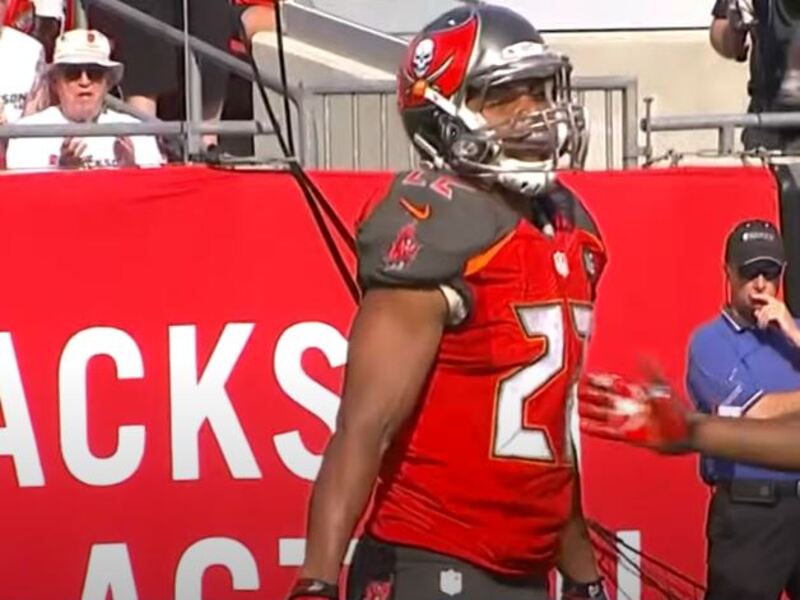
With a police investigation, an autopsy and CTE testing all unfinished, the former NFL running back’s family is left waiting as civil rights attorney John Burris steps in.
Former NFL running back Doug Martin died in Oakland police custody on Oct. 18. He was 36 years old. Nearly five months later, the circumstances surrounding his death remain unresolved, the investigations are unfinished and his family is still waiting on answers from multiple directions at once.
Martin played seven seasons in the NFL, spending six with the Tampa Bay Buccaneers and one with the Oakland Raiders. He rushed for 5,356 yards and 30 touchdowns across his career. His parents called police the night he died seeking medical assistance for their son, who was struggling with mental health issues. What followed has since become the subject of criminal, administrative and medical investigations with no clear resolution in sight.
What happened that night
Martin left his home in a disoriented state during the early morning hours and entered a neighbor’s residence two doors away in the East Oakland hills. Officers responding to a reported home break-in encountered him at the scene. According to the Oakland Police Department, Martin became unresponsive after a brief physical encounter with officers who were taking him into custody. He was transported to a nearby hospital, where he later died.
Five officers were present during the arrest. All five have been placed on paid administrative leave consistent with department policy. The Oakland Police Department subsequently released 911 calls, body camera footage and surveillance video from the night of the incident, though the full body camera footage has not been made available to the public.
Who is now involved
Martin’s family has retained civil rights attorney John Burris to represent them as the investigation continues. Burris is a prominent figure in Oakland legal circles with a long history of handling cases involving law enforcement and civil rights. His involvement signals that the family is taking a careful and deliberate approach before deciding on any legal course of action.
Burris said the family has not yet determined whether to pursue a lawsuit against the Oakland Police Department or the city. That decision is being held until the full body of evidence has been reviewed. He described the cause of death as still unclear and said the family is waiting on several fronts simultaneously before drawing any conclusions.
The investigations that are still open
Four separate entities are examining what happened. The OPD’s Homicide Section and Internal Affairs Bureau are both conducting investigations, as are the Police Commission’s Community Police Review Agency and the Alameda County District Attorney’s Office. As of this week, the Oakland Police Department said it had no new updates to share.
The Alameda County Coroner’s Bureau has also not yet completed its autopsy report. The delay is tied to pending toxicology results, which are needed to determine whether Martin had any substances in his body at the time of his death. Toxicology testing typically takes six to eight weeks under normal circumstances. The results in this case have taken considerably longer.
Burris said he has reviewed a portion of the officers’ body camera footage but described it as a compiled summary rather than the complete recording. He said that partial view was not sufficient to determine whether any officer engaged in misconduct during the encounter. A 2018 California transparency law generally requires law enforcement agencies to release body camera footage within 45 days of a critical incident, but an active investigation exemption has kept the full footage from being released publicly.
The CTE question hanging over everything
Perhaps the most consequential unknown is a medical one. Martin’s brain was sent to Boston University’s Chronic Traumatic Encephalopathy Center shortly after his death so specialists could examine it for CTE, a degenerative brain disease linked to repeated head trauma. The condition is common among athletes who played contact sports and military veterans who experienced combat exposure. It can only be confirmed after death.
The examination has not been completed. If CTE is found, it could reshape how the family and their legal team interpret the events of that night and what role, if any, the condition may have played in Martin’s behavior before his death.
Burris acknowledged the frustration of waiting without resolution and said the delay, while disappointing, was not entirely unexpected given the complexity and public profile of the case. His most recent communication with the Oakland Police Department produced nothing of critical importance, he said.
Martin’s family is still waiting. So is everyone else.