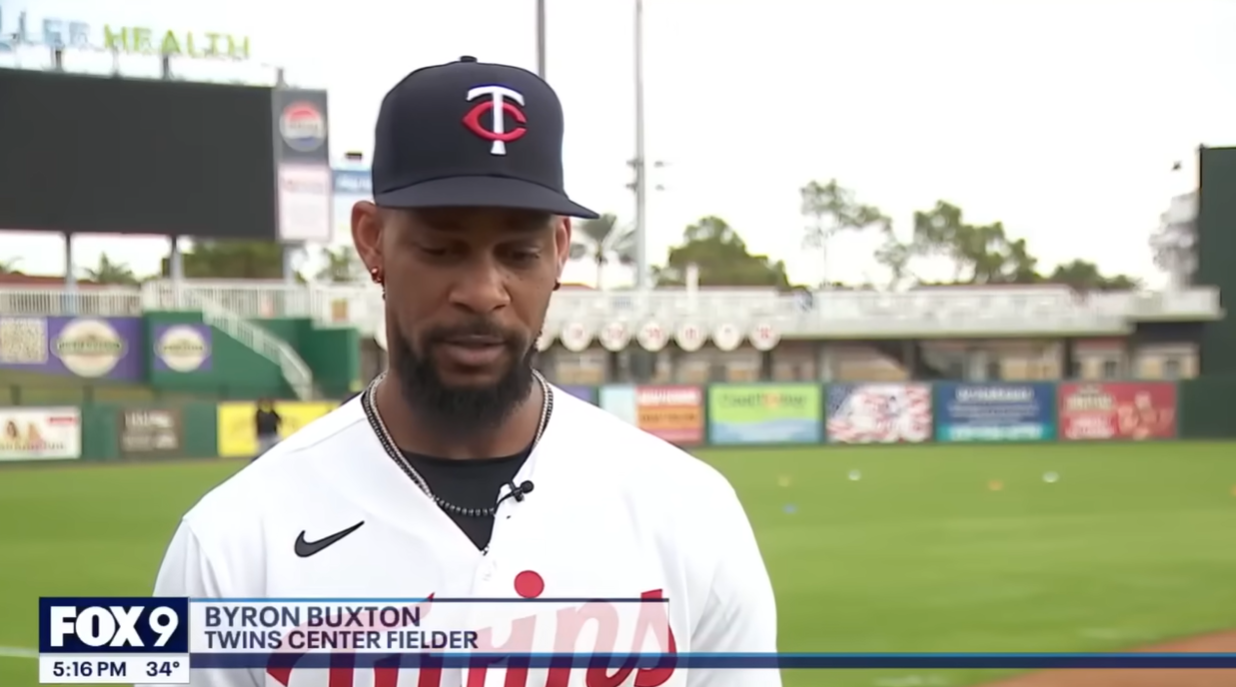
The Twins center fielder has erupted into one of the most productive power hitters in baseball.
Byron Buxton is in the middle of one of the most extraordinary power stretches in Minnesota Twins history, and the numbers are beginning to raise questions that once would have seemed far fetched including whether the center fielder could eventually threaten a franchise home run record that has stood for more than six decades.
Over his last 44 games, Buxton has hit 20 home runs while slashing .279/.337/.645. No hitter in baseball has posted a higher slugging percentage during that span, and his mark sits 28 points clear of the next closest player. The only other hitter to reach 20 home runs in that same window is Kyle Schwarber, who needed six additional games to get there.
A rough beginning that made the turnaround even more striking
The surge is all the more remarkable given how the season began. Through his first 14 games, Buxton went without a home run and batted just .182 with a .531 OPS, collecting four extra base hits while striking out at a 17 to 5 ratio against walks. The slow start was widely attributed to his participation in the World Baseball Classic with Team USA, which disrupted his normal spring training routine and left him searching for timing during the opening weeks of the regular season.
What followed has been a complete transformation.
Joining 4 legends in Twins history
Buxton’s recent run places him alongside just four other hitters in franchise history to record more than 20 home runs across a 45 game span. Those players are: Harmon Killebrew in 1964, Kent Hrbek in 1987, Brian Dozier in 2016 and Nelson Cruz in 2019.
The names carry serious weight. Killebrew finished the 1964 season with 49 home runs, still the highest single season total in franchise history. Hrbek hit 34 that same year Minnesota claimed its first World Series title. Dozier blasted a career high 42 in 2016, and Cruz led the Bomba Squad with 41 in 2019 as the Twins set a major league record with 307 team home runs.
Buxton now sits alongside all of them.
The surprising reason behind the power explosion
The mechanics behind the surge are counterintuitive. Buxton’s bat speed has actually declined slightly, dropping from 75.0 mph last season to 74.0 mph this year. For most hitters, reduced bat speed signals diminished power. For Buxton, it appears to have had the opposite effect.
The slight dip seems to have widened his timing window against off speed pitches. He is swinging over fewer breaking balls, making more consistent contact on the barrel and covering spin more effectively than at any point in his career. While he is occasionally a touch late on fastballs, his improved performance against secondary pitches has more than compensated for it. He has given up very little against velocity while becoming meaningfully better against breaking and off speed offerings a tradeoff that has unlocked a new tier of offensive production.
It is worth noting, however, that this adaptation is also a natural part of aging, and further decline in bat speed down the road remains likely.
Is a 50 home run season actually possible?
Killebrew’s franchise record of 49 home runs has survived more than 60 years and several legitimate threats. The question of whether Buxton can become the first Twin to reach 50 in a single season no longer feels like an exercise in wishful thinking.
He has already accomplished this while dealing with both hip and shoulder issues that cost him time on the field a reminder that staying healthy remains the single biggest variable in any projection involving Buxton. If he continues producing at or near his current rate and avoids a significant injury, the record is within range.
Twins fans have spent years wondering what a fully realized Buxton season might look like. That answer appears to be unfolding right now.