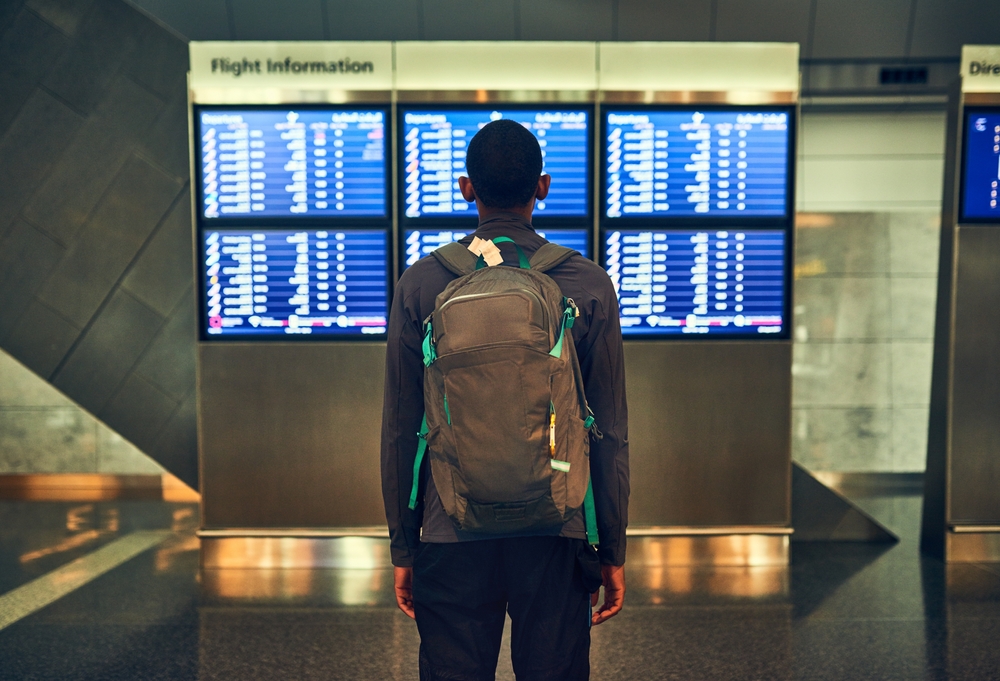
Ferocious gusts cripple a critical safety system, leaving hundreds of thousands of travelers in limbo as Chicago battles one of its fiercest wind events in recent memory.
O’Hare Grinds to a Near-Halt
Chicago’s O’Hare International Airport — one of the nation’s busiest air travel hubs — descended into widespread disruption Friday morning after ferocious winds triggered a critical equipment failure, grounding and delaying close to 1,000 flights and stranding untold thousands of travelers mid-journey.
By mid-morning, the Federal Aviation Administration had confirmed that a ground radar outage caused by heavy winds was responsible for the cascading delays. Technicians were deployed to address the problem, but the FAA warned that significant delays were expected to stretch well into the evening — potentially lasting until 9 p.m. or later. The average delay hovered around 84 minutes, according to FAA data, with the FlyChicago website listing more than 900 affected flights as of 10:25 a.m.
The disruption marked another bruising chapter for Chicago’s aviation infrastructure — and for a city already battered by an unusually violent stretch of severe weather.
The System That Failed — and Why It Matters
At the center of the breakdown was the Airport Surface Detection Equipment, widely known in aviation circles as ASDE — a sophisticated ground radar system that air traffic controllers rely on to monitor the precise positions of aircraft on taxiways and runways. The system integrates GPS technology to alert controllers in real time if a plane inadvertently crosses onto an active runway, a scenario that can have catastrophic consequences.
When winds exceeding 60 miles per hour raked across the Chicago area, the equipment was knocked offline. In response, the FAA issued a ground stop at O’Hare — temporarily halting all departures — before transitioning to a more measured ground delay program, slowing the flow of outbound flights to manageable levels while crews worked to restore the radar system.
The failure illustrated just how vulnerable even modern, technologically sophisticated airport infrastructure can be when nature intervenes on its own terms.
Chicago Battered by 60 MPH Gusts
A high wind warning blanketed much of the Chicago metropolitan area throughout the day, with wind gusts recorded as high as 60 miles per hour. The conditions were severe enough to send road speeds plummeting, shake traffic cameras mounted near Midway Airport, and snap tree limbs across neighborhoods throughout the region.
The storm‘s reach extended well beyond the airport. By 9:30 a.m. Friday, more than 19,000 customers across the Chicago area had lost electricity, with Cook County bearing the brunt of the outages, according to data from ComEd, the region’s primary electric utility. The company said its crews had already restored power to more than 55,000 customers earlier in the morning — a significant logistical achievement given the circumstances.
ComEd: Rebuilding After Relentless Storms
What made Friday’s wind event particularly punishing was its timing. Just days earlier, on Tuesday, an EF3 tornado had torn through parts of the region, knocking out power for more than 27,000 customers and forcing ComEd crews to work around the clock to essentially rebuild portions of the electrical grid from scratch — completing that restoration in just two days.
David Perez, ComEd’s executive vice president and chief operating officer, acknowledged the back-to-back nature of the crises in a statement, pledging that the company would bring the same urgency to Friday’s outages as it had to the tornado recovery effort.
The dual disasters placed enormous pressure on utility infrastructure and emergency response teams throughout the greater Chicago area, raising questions about long-term grid resilience in the face of increasingly severe weather patterns.
Wind Disruptions Reach Indiana
The storm’s impact rippled beyond Illinois. Authorities in neighboring Indiana implemented a “wind ban” on the Indiana Toll Road, prohibiting high-profile vehicles — including triple-tractor trailers, long doubles, and oversize permit loads — from traveling on the stretch of highway running from the Illinois state line to the South Bend West Toll Plaza. The ban was set to remain in effect until 6 p.m. Friday.
The restriction added yet another layer of regional disruption to an already chaotic travel day, affecting freight and commercial transport across one of the Midwest’s most heavily trafficked corridors.
For the hundreds of thousands of travelers passing through O’Hare on any given Friday — whether heading home for the weekend, embarking on spring getaways, or navigating connecting flights — the day served as a stark reminder of how quickly a single atmospheric event can unravel even the most carefully laid plans.
Source: NBC 5 Chicago