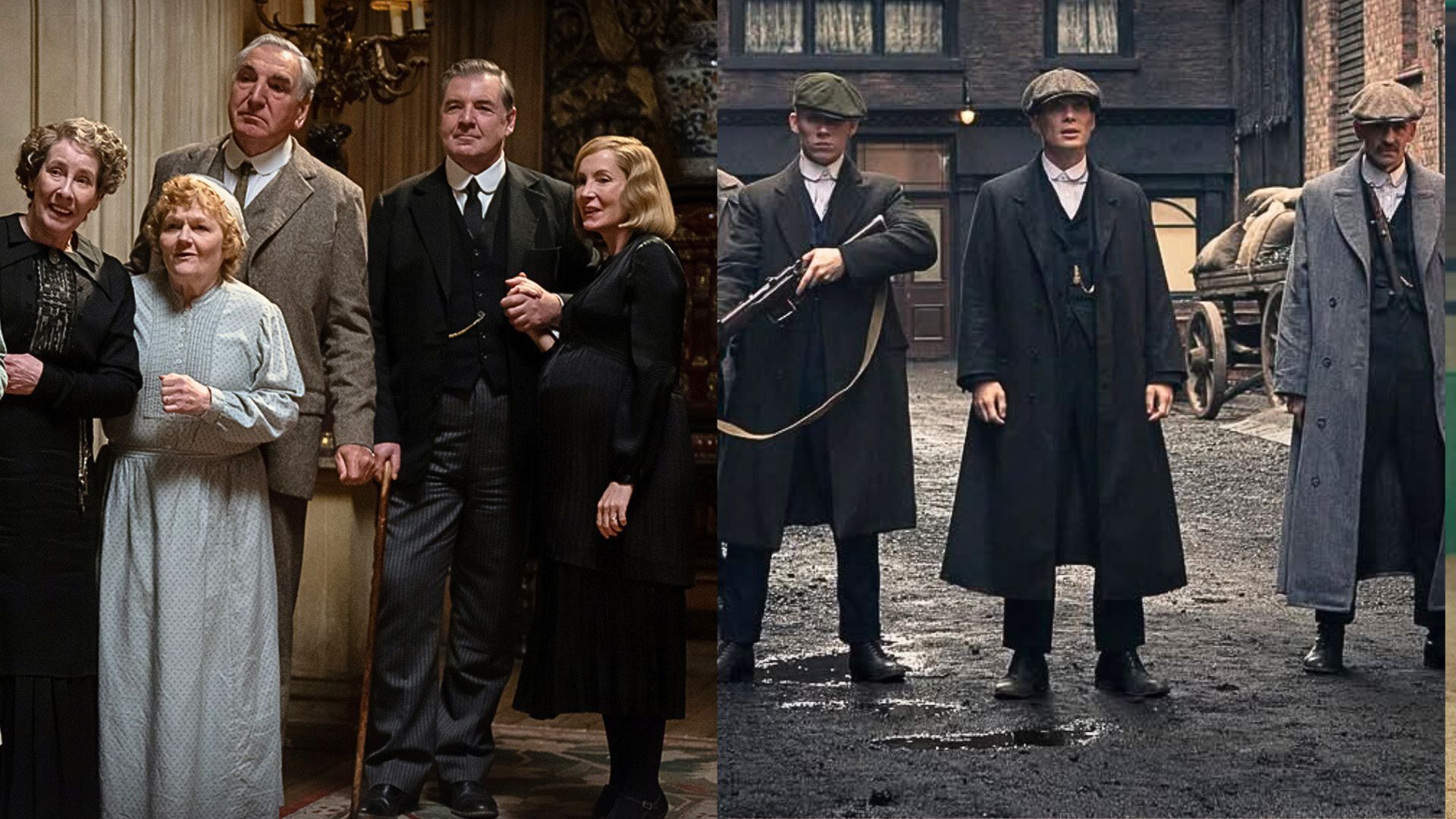

At first glance, Peaky Blinders and Downton Abbey may appear to share little more than a vaguely overlapping historical timeline. Yet critics and fans alike have long described Steven Knight’s gangster crime drama as the “anti–Downton Abbey,” a label that goes beyond surface-level comparisons and speaks to what each series represents about class, power and Britain’s past.
Where Downton Abbey offers a polished, nostalgic view of early 20th-century England through its fictional Crawley family, the Cillian Murphy-led series strips that era of romance, exposing its grit, violence and moral ambiguity.
Downton Abbey became the blueprint for period dramas and deservedly so. Its narrative, deeply rooted in stately homes and inherited privilege, used the upstairs-downstairs dynamics to create a sense of comfort and civility that cushioned its darkest moments. On the other hand, Peaky Blinders thrust the audience into the sooty industrial slums of Birmingham through its protagonist Tommy Shelby, a decorated war veteran who suffers from PTSD.
There are no dinner parties or lavish family estates to take the blow in Peaky Blinders. The Crawley family’s comfort is replaced with smoke-filled streets, betting shops and noisy factories echoing the political unrest of the time period.
More on this in our story.
The Peaky Blinders producers call their British drama anti-Downton Abbey
While Peaky Blinders is a celebrated British series now, back in 2013, when the small Irish production was about to make its humble beginnings, it was another period drama that promised a look at the British population in the early 20th century. As a result, it naturally faced comparisons with the standard period drama, Downton Abbey. From its British setting to the time period, Knight’s historical series faced much comparison with Julian Fellowes’ classic and beloved series.
However, fans who tuned into the initial seasons of the Murphy-led series were quick to realize its similarities with Downton Abbey are limited to the time period. In fact, the series positioned itself as an antidote to Downton Abbey, spotlighting a starkly different class of British society, one worlds away from the fictional aristocratic Crawley family.
This view was also shared by the Peaky Blinders producers, who were quick to debunk the series’ similarities with Downton Abbey. While Fellowes’ drama series brought an upper-class melodrama to life, Knight’s series offered a gritty look at the British working class.
In an interview with The Hollywood Reporter, producer Caryn Mandabach credited this major difference for the record-breaking success of Peaky Blinders:
“Class is at the center of a very big dialog in the U.K. and has been forever. I think the reason why Peaky Blinders is exceptional is because it was the first period drama to bring the working class into focus. You think of England in that time and most people imagine castles, aristocrats. But 95 percent of British people then belonged to the working class.”
While the Crawley family sipped their evening tea in the lavish dining room of their family estate in the Yorkshire region, the Shelbys got down and dirty, fighting against menacing enemies on the sooty Birmingham streets. The audience embraced the Crawley family (and their servants’) melodrama wholeheartedly, which is evident in the multi-season run and movie sequels of Downton Abbey but Knight’s series offered a peek at a different UK.
The Crawley family dynamics, albeit fun to watch, were more of a fantasy for the audience. However, the struggles of the working-class Shelby family felt real as most of the economic and social issues explored in Peaky Blinders remain relevant, even in today’s world.
In another interview with Digital Spy, Peaky Blinders producer Laurie Borg shut down all comparisons with this blunt (yet true) comment:
“What we’ve tried to do is the complete opposite of Downton [Abbey]. Which I think is brilliant for many reasons… but for me is probably the dullest television.”
Production designer Grant Montgomery added:
“I don’t think this is a cosy type of period. This is much more gritty. It is darker. It’s not safe.”
While Downton Abbey features its fair share of tragedies, war and social issues, the elevated status of the Crawley family in the high British society sets them apart from Tommy Shelby’s family. Any surface-level similarities quickly dissolve because, as Montgomery himself noted, Knight’s series is far from a cosy period drama. Peaky Blinders managed to carve out a class of its own, offering a chilling peek at the real struggles and hardships faced by the British working class in the early 20th century, an angle rarely explored in historical shows.
For the latest scoops on your favorite TV shows and movies, follow SoapCentral.
Edited by Aashna