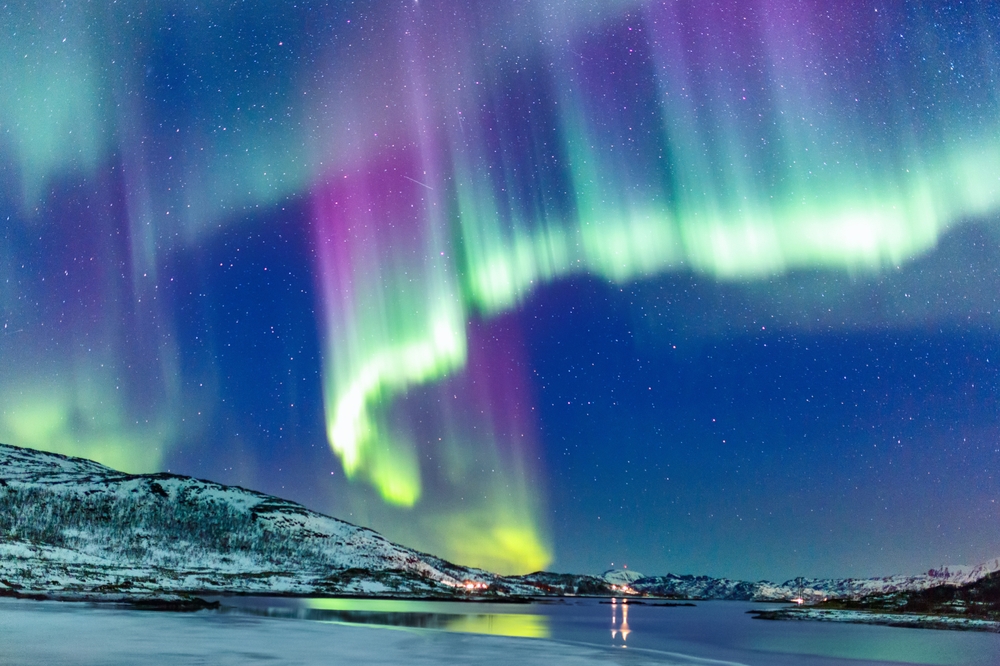
A G2 geomagnetic storm is giving millions of Americans a rare chance to spot the aurora borealis Thursday and Friday nights — but clouds may get in the way.
Skywatchers across a large swath of the United States have a rare opportunity to witness the northern lights this week, as a geomagnetic storm pushes the aurora borealis farther south than usual. According to the National Oceanic and Atmospheric Administration’s Space Weather Prediction Center, up to 17 states fall within the viewing zone for Thursday night, March 19, with an encore possible Friday night, March 20.
The catch? Stubborn cloud cover, rain and even snow in some regions could dim or completely block the show for many hopeful viewers.
Which 17 states are in the viewing zone?
NOAA uses a red view line on its forecast map to indicate the southernmost boundary where the aurora might be spotted on the northern horizon. For Thursday night, that line sweeps across a wide stretch of the country, placing the following states in play: 1) Idaho, 2) Illinois, 3) Iowa, 4) Maine, 5) Michigan, 6) Minnesota, 7) Montana, 8) Nebraska, 9) New Hampshire, 10) New York, 11) North Dakota, 12) South Dakota, 13) Oregon, 14) Vermont, 15) Washington, 16) Wisconsin and 17) Wyoming.
Michigan sits squarely in the forecast zone for both nights, with NOAA projecting aurora visibility across the entire state. That said, local National Weather Service offices are warning that cloudy skies will blanket much of Michigan throughout the viewing window, and portions of the state could contend with snow, rain or freezing rain — conditions that make spotting the lights considerably more difficult.
What is driving the display?
The celestial event is being powered by a G2 geomagnetic storm, which refers to a worldwide disturbance of the Earth’s magnetic field. NOAA is forecasting a Kp index of 6 for Thursday night. The Kp index is a scale running from zero to 9 that scientists use to measure the severity of magnetic disturbances in the region of space near Earth. A reading of 5 or above is generally the threshold at which the northern lights can become visible across Michigan and other northern-tier states. NOAA is classifying the expected impacts as minor overall, though a Kp of 6 still represents a meaningful level of activity.
What makes the northern lights glow?
The aurora borealis forms when charged particles carried by the solar wind collide with gases in Earth’s atmosphere, producing the dancing waves of light that have captivated observers for centuries. The color of the display depends on which type of gas is being energized and how much energy is involved in the exchange, according to NASA. Oxygen produces either the familiar greenish-yellow hue most people associate with the aurora or a deeper red glow, while nitrogen typically creates shades of blue. Both gases also release ultraviolet light during these collisions, though that portion of the spectrum is invisible to the human eye and requires specialized satellite cameras to detect.
Auroras are most commonly seen in greens, pinks and reds, and often layer several shades of those colors simultaneously, creating an effect that can shift dramatically from minute to minute.
Tips for the best viewing experience
For anyone hoping to catch a glimpse, experts recommend finding a dark location away from city lights with a wide, unobstructed view of the northern horizon. Clear skies are essential — no amount of geomagnetic activity will punch through thick cloud cover. Viewing is generally best in the hours around midnight when the sky is darkest.
If the lights are faint or you are struggling to see them with the naked eye, try using your smartphone camera set to night mode. Phone cameras are often more sensitive to aurora activity than the human eye and can reveal colors and movement that might otherwise go unnoticed. Holding the phone steady while capturing the image will produce the clearest results.
The lights are expected to be present both Thursday and Friday nights, giving viewers two chances to catch the display if conditions improve.
Source: Detroit Free Press