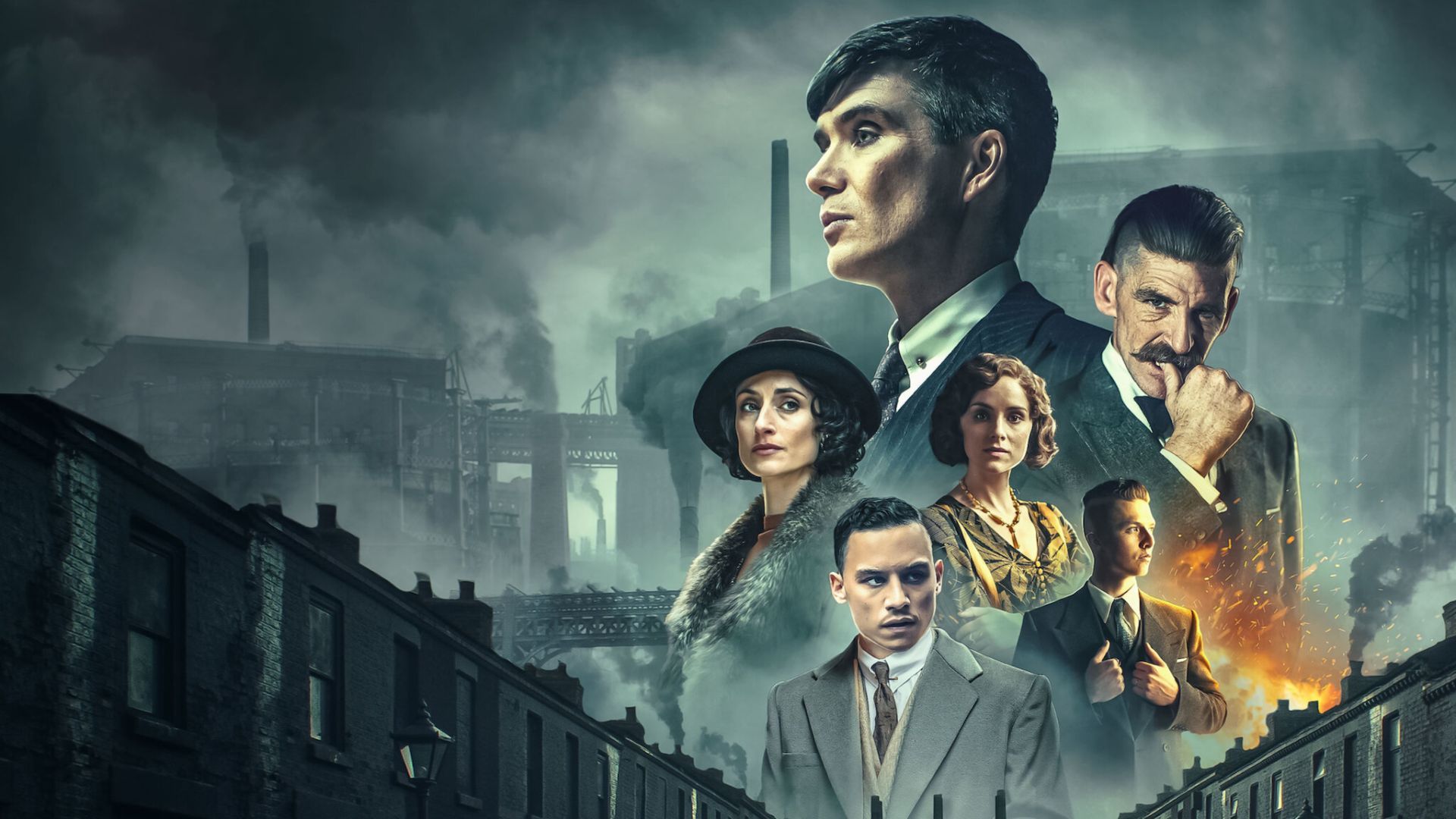

Very few TV dramas make such a bold statement as Peaky Blinders did. When it aired in 2013, the very first episode of the BBC period crime series made a stunning opening statement that defined the rest of the show.
Writer Steven Knight has said that the opening credits sequence is an experience that “no one was expecting”, and it is difficult to disagree. The opening credits sequence of Peaky Blinders, a man on horseback, billowing smoke, and the pounding beat of a Nick Cave song, was a statement of what this show was.
How Peaky Blinders’ opening credits became iconic
In a recent interview with GQ, Knight said:
“I just wanted it to start in a way that no one was expecting. I wanted the whole thing to sort of be a bit of a western set in Birmingham. So here is someone riding into town, like they do in a western, and you’ve never seen anyone like this, and you’ve never seen a story like this. So then it cuts to people speaking in Chinese, and the caption says Birmingham 1919.”
The first scene that kicks things off is deceptively straightforward. Tommy Shelby, played by Cillian Murphy, rides in atop a black horse, rushing through the grimy streets of Birmingham’s Small Heath, pushing women and children to the wayside. According to Knight, he wanted the series to open with an image that took you into the realm of myth, to start with a picture that wasn’t a dirty, gritty period drama in the ordinary sense. He wanted something bigger. Something legendary.
Memories of his childhood proved hugely influential in creating this image. His own experiences of life in Birmingham’s Irish families had lingered decades in his mind: bare-knuckle fighters, horse-fair gypsies, gang-members in pristine suits and ties replacing the mud of first-world-war fatigue.
That childhood feeling of awe was precisely what Knight wanted the audience to experience from the very first shot. Not sympathy for the workers but marvel. As Knight told Den of Geek, his guiding philosophy for the show was: “Let’s do legends.”
The initial scene is shot in one take. Director of Photography George Steel revealed to Esquire Oral History that the budget was totally spent on the shot, all the special equipment used was virtually “A Russian arm”, a crane camera truck, at the time costing £10,000 per day.
In context, the budget for the whole of the first series of Peaky Blinders was around £7.5million, a tiny proportion of the budgets U.S. prestige dramas were working with at that time. Investing such a large chunk into just four minutes of opening shots was a risk. One that paid off.
Peaky Blinders director Otto Bathurst was determined to do it in a single take, not based on the history of Birmingham but inspired by sci-fi, such as Blade Runner and Mega-City One from Judge Dredd. The skyline that is created feels huge and of another world, even mythical, which was what Knight wanted.
Music holds an equally important place in the beginning. The foreboding music that emerges even before the first shot appears is that of Red Right Hand by Nick Cave and the Bad Seeds, a song that was released in 1994, two decades before Peaky Blinders.
Speaking to the New York Post, Knight said that although he intended the song to be used only in the first episode, the match between the music, the lyrics, and the world of the TV series was too perfect, so he kept it as the series theme. According to him:
“The lyrics conjure up our industrial landscape.”
The name of the song is taken from the epic poem by John Milton, Paradise Lost, where the phrase signifies the wrathful hand of God. Its main character, dark, triumphant, and corrupt, maps eerily well onto Tommy Shelby. The “tall handsome man with a dusty black coat” may also be construed as placing Tommy in the position of control as he towers over the Small Heath residents on his black horse.
Even Cillian Murphy has admitted the music has a rebelliousness to it that felt perfectly suited to Peaky Blinders. It so completely became associated with the series that when it was omitted from the 6th Season’s opening credits, fans showed distress on social media.
The opening sequence of Peaky Blinders holds so well because everything in it supports everything else. The visual grammar of slow shots, close-ups of boots and coat fabric, fire and smoke, reflects that creeping dread of the song. The setting is at once historical and oddly modern. Building juxtaposition with the modern setting is an effective way of making the story come alive.
Edited by Sahiba Tahleel