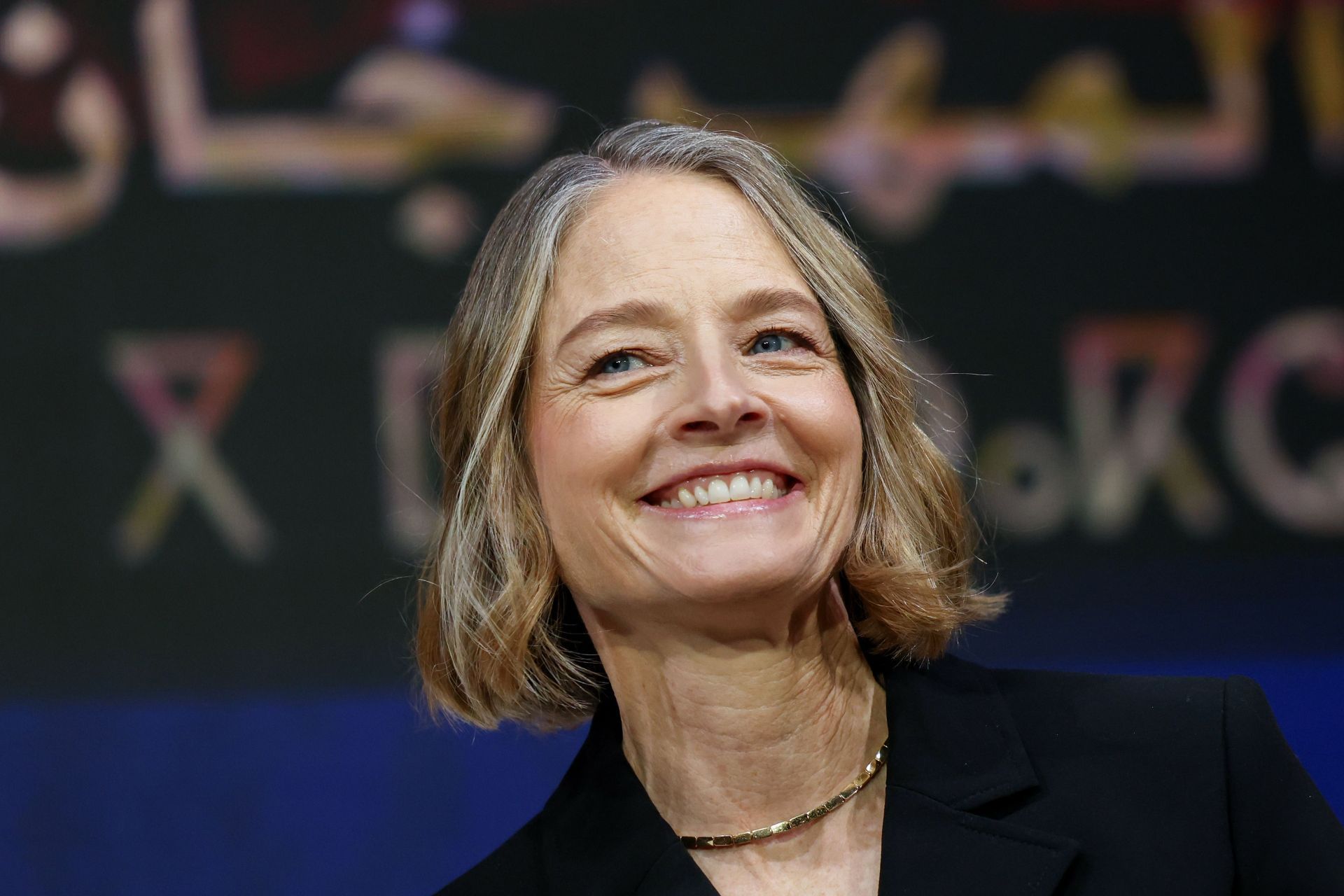

Jodie Foster, the two-time Oscar winner, has made multiple headlines recently after publicly weighing in on Brad Pitt’s F1. Speaking at the Aspen Festival of Ideas, the sixty-three-year-old didn’t mince her words. She picked the racing film as her main example of a pattern she’s been noticing in Hollywood. In her opinion, movies have started feeling so perfectly put-together they might as well have come out of a machine.
“I don’t say this disparagingly — how could I? This movie went on to make millions of dollars. But I look at a movie like F1 and I’m like, ‘F1 was made by AI.’ Wasn’t it?” she said.
That being said, The Silence of the Lambs actress was quick to make one thing clear. She wasn’t pointing fingers at the filmmakers for plugging anything into a computer. Jodie Foster’s issue was with how the film felt, as the story hit every beat so cleanly, so precisely, it read like something generated to a specification.
“I mean, the structure was exactly the structure that you would learn in school. The actors say the lines exactly the way it would be written if a computer was writing exactly what would be the right thing for that time. And they were able to dominate the technology to make something big and beautiful and potentially where a lot of the information comes from other places,” she explained.
Despite her concerns, Jodie Foster shares why she believes unions could be the answer to AI in Hollywood:
As per a report shared by The Wrap, F1 walked away with the Academy Award for Best Sound, and also picked up nominations for Best Picture, Best Film Editing and Best Visual Effects. Not to mention the $634 million it pulled in at the global box office.
That being said, Jodie Foster wasn’t taking shots at AI itself. She did acknowledge, though, that the technology has come with a real cost to people working in the industry. Still, she wasn’t without hope. Foster shared that she believes unions could end up being the thing that keeps the balance in check.
“Hopefully, things like unions will be able to come in and say, you can use my actor 20 times, but you’re going to pay him 20 times. And I think that’s fair. I think that if we can come up with a way of saying we will participate with technology as long as we still have the dignity of the craft that we make,” she shared.
Jodie Foster reveals her own film used AI, as Hollywood remains split on the technology:
It turns out Foster wasn’t speaking purely as an outside observer. Her 2025 film A Private Life, directed by Rebecca Zlotowski, actually used AI for a dream sequence. She did, however, make her position on how the technology ought to be used pretty clear.
“What we all would love is that filmmakers would be able to dominate AI, and never lose sight of that. If we are able to dominate AI consistently over time, we will be able to make things that reflect us, and we can make things better,” she shared.
As per a report shared by The Wrap, AI remains a deeply divisive subject in Hollywood. Scarlett Johansson and Joseph Gordon-Levitt have both spoken out against it publicly, pushing for stronger protections for those working in the industry.
Not everyone sees it that way, though. Reese Witherspoon has urged women to get comfortable with AI tools. Sandra Bullock, for her part, said it was time to “lean into” the technology.
Jodie Foster on filming in French, her fear of AI and why Charlie Brooker predicted it all:
Foster had also made headlines last month, sitting for an interview with Radio Times magazine to discuss A Private Life, a French murder mystery where she plays a therapist who starts digging for answers after one of her patients dies. Asked whether she had been actively searching for another French role, given her last was back in 2004’s A Very Long Engagement, she was candid.
“Yes, I’d been looking for it for a long time, but I just hadn’t found the right thing. I knew that I didn’t want to work with a first-time director, because I’m scared in the language. I feel like I wouldn’t know how to do that. The first day on set, I kept saying, ‘I’m super scared,'” she shared.
The conversation then shifted to AI, as Jodie Foster was asked how she felt about the technology creeping into filmmaking after her director used it on the very same project.
“I don’t have big opinions about it. I’m scared to death, like everybody else. I made movies and TV shows about this, like Black Mirror, for example. I don’t know what it is with Charlie Brooker,” she said.
Brooker is the writer and creator behind Black Mirror, the dystopian anthology series that has long explored humanity’s complicated relationship with technology. Asked if she meant he was prescient, Jodie Foster didn’t hold back.
“He’s like Arnold Schwarzenegger in The Terminator — sent back in time and predicts everything. But I think that his whole philosophy of that show is the idea that we’re projecting our worst vices, and our worst human instincts, onto a black box, and it’s just reflecting back to us, and that really is our experience. The problem is that we don’t control it any more,” she explained.
Edited by Ryan D’souza