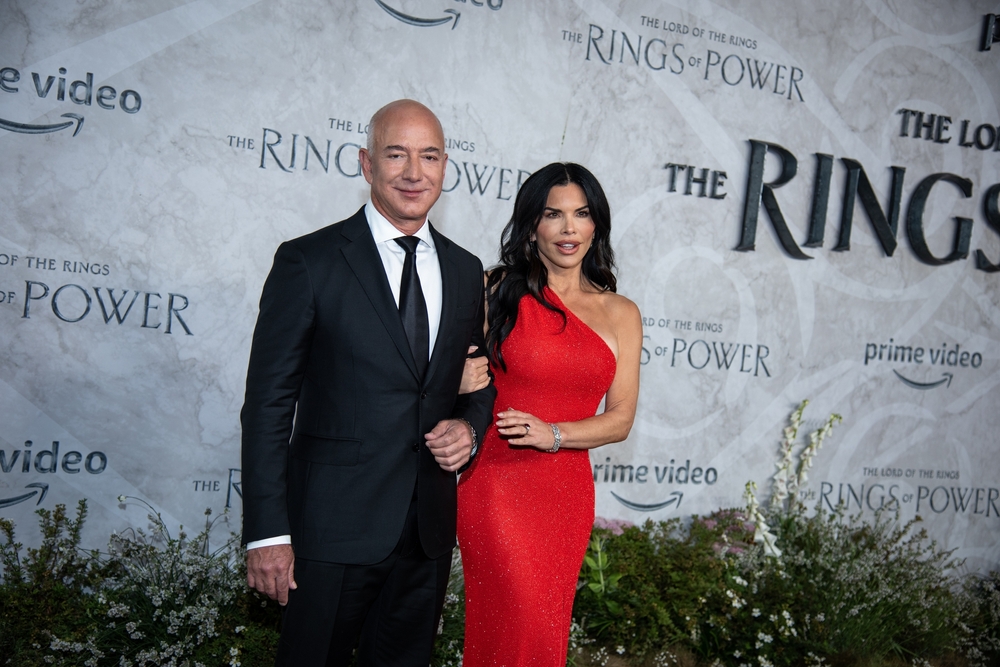
With $7 billion left to deploy by 2030 Lauren Sánchez Bezos is leading the charge on climate giving
In 2020, Jeff Bezos made the largest individual philanthropic commitment to climate and nature in history: $10 billion, to be fully deployed by 2030 through the Bezos Earth Fund. Five years in, the fund has distributed approximately $2.4 billion across 335 grants. That leaves roughly $7 billion to be spent before the decade ends, and the person setting the pace is Lauren Sánchez Bezos.
Sánchez Bezos has served as vice chair of the Bezos Earth Fund since its early days, a role she held before she and Bezos married last summer in Venice. Over the past year she has become the more visible figure in the couple’s philanthropic work, stepping into public-facing announcements and shaping the direction of the fund’s giving across climate, ocean conservation, artificial intelligence, and homelessness.
What Lauren Sánchez Bezos has been doing with the money
The scope of her recent announcements reflects how seriously the fund is beginning to accelerate its spending as the 2030 deadline approaches. In September 2025, she announced $37.5 million in grants to protect 835,000 square miles of water surrounding 12 Pacific Island nations and territories, part of a $100 million commitment the fund describes as one of the boldest ocean conservation efforts ever attempted.
In October, she unveiled $30 million in awards for the fund’s AI Grand Challenge for Climate and Nature, a program committing up to $100 million to artificial intelligence-driven environmental solutions. Fifteen teams each received $2 million to advance work on problems including biodiversity loss and food insecurity.
In December, she announced a $102.5 million commitment to organizations fighting homelessness across all 50 states, Washington D.C., Puerto Rico, and Guam. That amount comes from the Bezos Day One Families Fund, which has now donated more than $850 million total as part of a larger $2 billion commitment to stable housing and tuition-free preschools in under-resourced communities.
The fund’s broader portfolio includes $1 billion committed to transforming food and agriculture systems, $100 million to the World Wildlife Fund for nature-based climate solutions, $110 million for habitat restoration and climate science, a $3.5 million grant to accelerate nuclear energy deployment, and a $4.8 million partnership with the Earthshot Prize to fund 48 climate innovation projects globally.
How Bezos compares to MacKenzie Scott
The $10 billion commitment is an extraordinary number in isolation. In context, it tells a more complicated story. Bezos’s net worth currently sits at approximately $266 billion, making him the fourth-richest person in the world. His total lifetime charitable giving amounts to approximately $4.6 billion, less than 2% of that fortune.
By comparison, his ex-wife MacKenzie Scott has donated $26.4 billion over seven years, representing roughly 46% of her estimated $35.4 billion net worth. In 2025 alone, Scott donated $7.2 billion, which exceeds the entirety of Bezos’s lifetime giving in a single year. Scott has also signed the Giving Pledge, the commitment championed by Warren Buffett, Bill Gates, and Melinda French Gates encouraging billionaires to donate the majority of their wealth. Bezos has not.
In a 2022 interview, Bezos said he intends to give away most of his wealth during his lifetime but acknowledged the challenge of doing so effectively, comparing the difficulty of meaningful philanthropy to the challenge of building Amazon.
What comes next for the Bezos Earth Fund
The fund is in operational transition. In July 2025, Bezos replaced founding CEO Andrew Steer with Tom Taylor, former head of Amazon’s Alexa division. The hire signals a shift toward faster execution as the 2030 spend-down deadline draws closer.
With approximately $7 billion left to deploy in roughly four years, the pace of giving will need to accelerate significantly. Lauren Sánchez Bezos is positioned as the face of that acceleration, and her track record over the past year suggests she is not approaching the role as ceremonial. Whether the fund’s remaining commitments match the urgency of the climate moment they are intended to address remains the central question.