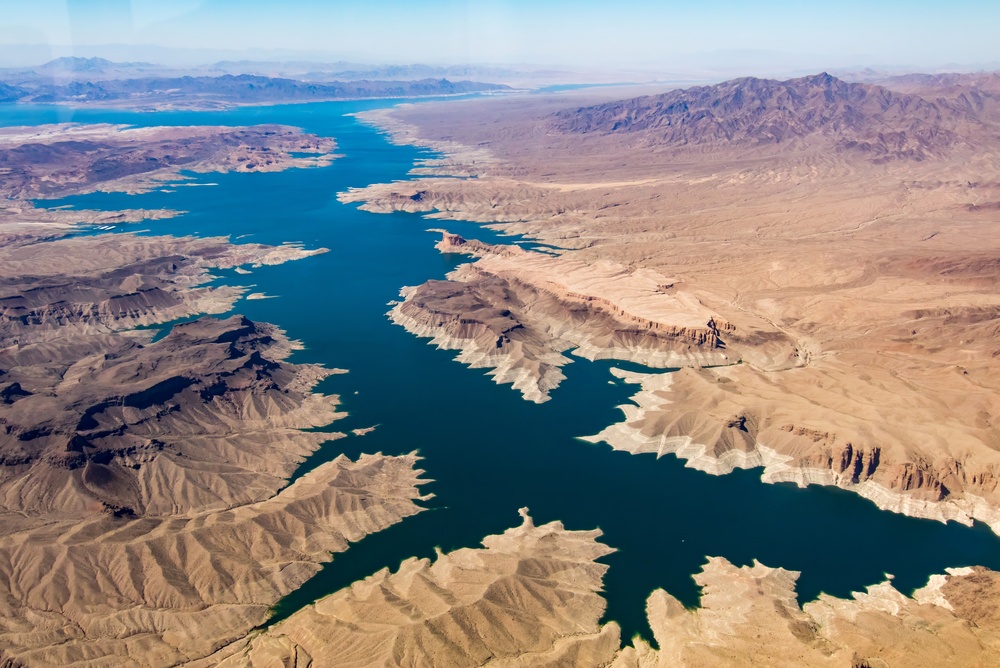
Experts warn the Colorado River Basin is approaching a threshold that could leave millions of people — and entire farming communities — without reliable water.
Lake Mead Faces a Dangerous Tipping Point
Lake Mead and Lake Powell, the two largest reservoirs in the American West, are closing in on a breaking point that water researchers are calling a potential “system crash” — a moment when the reservoirs stop functioning as actual storage buffers and simply pass water through as it arrives, leaving the region entirely at nature’s mercy.
A new report from a coalition of leading Colorado River researchers and former water officials warns that the system is closer to that edge than most people realize. At the heart of the alarm is a specific elevation threshold: if Lake Mead drops to 975 feet above sea level, it would effectively lose its capacity to store water in any meaningful way. As of last week, the reservoir sat at approximately 1,049 feet — but a recent Trump administration decision to reduce water releases from Lake Powell could push Lake Mead roughly 28 feet lower by July 2027, well below its previous record low.
That’s not a small margin. That’s the difference between a functioning reservoir and an open channel.
The Colorado River Basin Is Running on Empty
The alarm from researchers follows yet another unusually dry winter across the Colorado River Basin, a system that supplies water to approximately 40 million people across seven Western states. The basin has faced persistent drought conditions for more than two decades, and the combined storage capacity of its two signature reservoirs has been in decline for years.
The situation at Lake Powell carries its own distinct dangers. If water levels there fall below 3,490 feet, structural vulnerabilities at Glen Canyon Dam could make it physically unsafe — or even impossible — to release water downstream. Federal managers have already taken emergency measures to prevent that scenario: reducing outflows and pumping water in from upstream sources to buy time. But those are finite tools, and experts say the window to use them is narrowing fast.
Without a dramatic change in weather patterns, there may not be another lever to pull.
What a System Crash Would Actually Mean
Despite the severity of the language, researchers are careful to note that a system crash would not immediately turn off the taps in major Southwestern cities. Urban centers like Las Vegas, Phoenix and communities across Southern California have invested heavily in backup water supplies and conservation infrastructure. Residents in those cities are somewhat cushioned — at least in the short term.
But not everyone has that cushion.
Agricultural users and rural communities, many of which depend almost entirely on Colorado River allocations, would bear the sharpest impact. Farms could face deeper cuts to water access, reduced crop yields and rising operating costs — pressures that would eventually reach consumers in the form of higher food prices.
Everyday Impacts Are Already Taking Shape
Even before any crash scenario materializes, the warning signs are already showing up in daily life. Lawn watering restrictions — the kind that require permits, limit watering days or ban outdoor irrigation during peak hours — are increasingly common across municipalities throughout Colorado and the broader Southwest. These measures, once considered extraordinary, are now routine management tools.
Beyond lawns and gardens, reduced reservoir levels could also diminish hydropower generation at both Lake Mead and Lake Powell, potentially driving electricity rates higher for the millions of households served by that grid.
A Silver Lining — For Now
There is one narrow path toward relief. Researchers note that a stronger-than-average snowpack season, potentially amplified by an approaching El Niño weather pattern, could temporarily ease the strain on the system. A well-timed surge of runoff might buy the reservoirs roughly two additional years before conditions deteriorate back into crisis territory.
Two years is not a solution. But in a system this stretched, two years can mean the difference between enough time to negotiate long-term water reduction agreements among the seven basin states — or not.
The Colorado River has sustained the American West for more than a century. Whether it can continue to do so depends heavily on choices being made right now — and whether the political will exists to make them before the water runs out.
Source: Independent